20-Gallon Long Planted Tank: Equipment and Planting Plan
Equipment and a planting plan for a 30-inch 20-gallon long: lights by length, filter sizing, substrate amounts, an optional CO2 path, and setup order.

A 20-gallon long, commonly about 30 x 12 x 12 inches, is one of the easiest footprints to plant: it is shallow enough for a modest light to reach the substrate and long enough for a layout with real depth. Choose a light that spans about 30 inches, a filter rated for about 20 gallons, and roughly 2 inches of substrate on average. Start low-tech with easy plants, and add pressurized CO2 later only if you want faster growth and are ready for the extra tuning.
This guide covers equipment and a planting plan for both paths: a low-tech tank with no injected CO2, and an optional upgrade to pressurized CO2. If you have not decided between them, low-tech vs high-tech planted tanks explains the trade-offs.
Assumed dimensions
This guide assumes the common US glass 20-gallon long of about 30 x 12 x 12 inches (length x width x height). That is typical, not a standard; brands vary, and rimless tanks in this volume often use different proportions. Measure your tank before buying a light, because fit depends on length. The gross volume of 30 x 12 x 12 inches works out to a little under 19 gallons, and the water volume is lower again once substrate and hardscape are in. The aquarium volume calculator works it out from your own measurements.
Do not confuse it with a 20 high, which is commonly about 24 inches long and taller. They hold similar volumes but need different lights. The 20-gallon light guide covers both shapes.
Why the 20 long is a good planted footprint
- Shallow water helps the light. Tropica notes that light decreases considerably with distance from the light source to the base of the tank. At about 12 inches tall, a 20 long is the same height as a common 10-gallon, so foreground plants sit close enough to a modest fixture.
- Length gives layout room. Thirty inches of length lets you build a slope, an off-center focal point, and open space without crowding, which is hard to do in a 20-inch tank.
- Twelve inches front to back is enough for three planting zones: foreground, midground, and background.
- More floor than a taller tank of the same volume. A longer, lower tank spreads the same water over more substrate, which means more room for rooted plants and more surface area for gas exchange.
The trade-off is that 30 inches needs a longer light than a 20 high, and a single short fixture can leave the ends dim.
Equipment checklist
| Item | Low-tech | Optional CO2 path |
|---|---|---|
| Light | Fits about 30 in; dimmable; schedule | Same light, run brighter; enough headroom matters |
| Filter | Rated for about 20 gal; gentle to moderate flow | Good circulation to spread CO2; inline diffuser option with a canister |
| Heater | Adjustable, sized for about 20 gal, if animals are tropical | Same |
| Substrate | Aquasoil, or inert gravel or sand with root tabs | Same; aquasoil is common |
| Test kit | Ammonia, nitrite, nitrate, pH | Add KH; a drop checker helps |
| Conditioner | Treats chlorine and chloramine | Same |
| CO2 system | Not needed | Cylinder, regulator with solenoid, needle valve, bubble counter, check valve, CO2 tubing, diffuser |
| Timer | Only if the light has no schedule | Needed for the solenoid |
If you already own a light that covers the full 30 inches and can be dimmed, keep it for a low-tech start. A tank of easy plants does not need new equipment just because it is planted.
Lights matched to a 30-inch tank
Choose by length first. Tropica's light guide gives a rough rule of thumb of about 10 to 20 lumens per liter for easy plants and 20 to 40 for medium plants. A nominal 20 gallons is about 76 liters, so easy plants need something like 750 to 1,500 lumens, and medium plants roughly twice that. Treat these as starting points: spread, depth, and how long the light runs matter as much.
| Product | Fits | Best for | Skip if |
|---|---|---|---|
 Fluval Plant 3.0 Bluetooth LED (32 W / 24-34 in (61-85 cm)) Fluval Plant 3.0 Bluetooth LED (32 W / 24-34 in (61-85 cm))Model 14521 | 24–34 in long | Planted tanks about 24-34 in long where you want app-programmed sunrise/sunset scheduling. | You want a light you can schedule without a smartphone app, or your tank length falls outside the bracket range. |
 Finnex Planted+ 3.0 (24 in) Finnex Planted+ 3.0 (24 in)Model PL-24S | 24–30 in long | Planted tanks about 24-30 in long where you want a simple built-in timer and dimmer with no app. | You want app control or custom color-channel scheduling. |
 Finnex Stingray 3.0 (30 in) Finnex Stingray 3.0 (30 in)Model VL-30S | 30–39.5 in long | Low- to moderate-light planted tanks about 30-39.5 in long where you want a simple built-in timer and dimmer. | You plan demanding high-light plants or a deep tank, or you want app control. |

Fluval Plant 3.0 Bluetooth LED (32 W / 24-34 in (61-85 cm))
- Best for
- Planted tanks about 24-34 in long where you want app-programmed sunrise/sunset scheduling.
- Skip this if
- You want a light you can schedule without a smartphone app, or your tank length falls outside the bracket range.
- Fits tanks
- 24-34 in (61-85 cm)
- Power
- 32 W
- Luminous flux
- 2350 lm
- Number of LEDs
- 168
- Input / operating voltage
- 100-240 V / 24 V
- Control
- Illuminated touch switch (off, all on, blue only, Bluetooth mode) with manual dimming; FluvalSmart Bluetooth app for 24-hour programmed cycle
- Mounting
- Extendable mounting brackets, placed on the outside of the aquarium frame; glass thickness 3-15 mm
- Rated LED life
- 50,000 hours
- Warranty
- 3-year limited
- Extendable brackets cover a 24-34 in tank-length range per the manual
- Programmable 24-hour light cycle via the FluvalSmart Bluetooth app
- 3-year limited warranty
- Programming a schedule requires a phone with the FluvalSmart app
- Dimming level set at the touch switch stays fixed until changed manually
- LED light source is not replaceable
The Fluval Plant 3.0 32 W is listed for 24 to 34 inch tanks, so 30 inches sits comfortably within its range. The catalog lists 2,350 lumens, roughly 31 lumens per liter in a nominal 20 gallons, which is in Tropica's medium range at full power. That makes it a good fit if you might add CO2 later: run it dimmed for a low-tech start and turn it up if you upgrade. Scheduling uses the FluvalSmart app over Bluetooth, and its brackets sit on the outside of the frame on glass 3 to 15 mm thick. Skip it if you do not want to program a light from a phone.

Finnex Stingray 3.0 (30 in)
- Best for
- Low- to moderate-light planted tanks about 30-39.5 in long where you want a simple built-in timer and dimmer.
- Skip this if
- You plan demanding high-light plants or a deep tank, or you want app control.
- Fixture length
- 29.49 in
- Max length with mounts extended
- 39.49 in
- Fixture width x height
- 2.34 x 1.30 in
- Input power
- 22 W
- PAR at 6 in
- 140 umol/m2/s
- PAR at 12 in
- 75 umol/m2/s
- PAR at 14 in
- 65 umol/m2/s
- PAR at 18 in
- 52 umol/m2/s
- Spectrum
- Includes 660 nm deep red LEDs; CRI > 92
- Control
- Inline controller: dimming 0-100%, daylight/moonlight modes, Auto 24/7 Lunar+ with 6H/9H/12H timer and adjustable daylight/moonlight intensity
- Water resistance
- PCB IP67
- Power supply
- UL listed
- Rated LED life
- 50,000 hours
- Mounting
- Adjustable sliding tank mounts
- Built-in 24/7 Lunar+ timer (6, 9 or 12 hours) with no app needed
- Manufacturer PAR chart lists 75 umol/m2/s at 12 in
- IP67-rated LED board and 660 nm deep red LEDs
- Timer offers only 6, 9 or 12 hour presets
- No app or per-channel color control
- Modest output for deep tanks (52 umol/m2/s at 18 in per Finnex)
The Finnex Stingray 3.0 30 in is a general-purpose light listed for 30 to 39.5 inch tanks, so a 30-inch tank is at the very bottom of its range: measure carefully. Finnex publishes PAR of 75 umol/m2/s at 12 inches for this model, lower than its Planted+ line, which suits easy plants without CO2. The inline controller has dimming and a 6, 9, or 12 hour timer. Skip it if you plan to add CO2 and grow demanding plants, if your tank is under 30 inches, or if you want app control.
The Finnex Planted+ 3.0 24 in is a third option. Its range of 24 to 30 inches uses the narrower of two published figures, so a 30-inch tank needs it fully extended, and the 23.5 inch fixture leaves several inches at each end with less direct light. Finnex lists 115 umol/m2/s at 12 inches. It suits keepers who want stronger output and a built-in timer, and who accept dimmer ends. For more detail, read the 20-gallon light guide and the Fluval Plant 3.0 vs Finnex Planted+ 3.0 comparison.
PAR and lumen figures come from each maker and are measured differently, so compare them within a brand rather than across brands.
Filter rated for about 20 gallons
A hang-on-back or sponge filter works for a low-tech 20 long. A canister keeps equipment out of sight, holds more media, and makes an inline CO2 diffuser possible later. The planted aquarium filter guide compares types, and the canister filters guide compares models.

Fluval 107 Performance Canister Filter (107)
- Best for
- A 10-30 US gal planted tank where you want external filtration with room for media.
- Skip this if
- Your tank is outside the 10-30 US gal range Fluval specifies for this size.
- Recommended aquarium size
- 10-30 US gal (40-130 L)
- Pump performance
- 145 US gal/h (550 L/h)
- Filter circulation
- 95 US gal/h (360 L/h) (measured with intake and output hoses of the same length)
- Vertical pre-filter area
- 514 cm2
- Basket volume
- 1.2 L
- Total chamber volume
- 2.0 L
- Canister volume
- 3.9 L
- Filter dimensions
- 7.5" x 7" x 13.7" (19 x 18 x 35 cm)
- Max water column height
- 1.45 m
- Rated by Fluval for 10-30 US gal aquariums, so sizing is straightforward.
- 3.9 L canister with 1.2 L of media basket volume.
- Shares the 07-series platform and service parts across sizes.
- Attached instant-prime handle for starting the filter (per the manual).
- AquaStop valve shuts off flow and locks the hoses to the canister cover for maintenance.
- More setup and maintenance (hoses, gasket lubrication) than a hang-on-back filter.
- Manual calls for yearly replacement of the motor head gasket and impeller as preventive maintenance.
Fluval rates the 107 for 10 to 30 US gallons, which puts a 20 long in the middle of its range. The Fluval 207 is rated for 20 to 45 US gallons, so a 20 long sits at its lower edge. Choose the 207 if you want more media volume and circulation for a heavily planted or CO2 tank, and keep the 107 if you want a smaller canister. Skip a canister if you prefer the simpler maintenance of a hang-on-back or sponge filter; Fluval's manual calls for yearly replacement of the 07 series' motor head gasket and impeller. The Fluval 07 series vs Eheim Classic comparison covers an alternative.
Heater, test kit, and conditioner
UF/IFAS Extension notes that aquarium animals cannot regulate their own body temperature, so tropical livestock needs a heater: an adjustable model sized for about 20 gallons and a separate thermometer. A liquid test kit covering ammonia, nitrite, nitrate, and pH is essential for cycling; see the water test kit guide. Treat all tap water with a conditioner.
How much substrate does a 20 long need?
Tropica suggests sloping substrate from at least 3 to 4 cm (about 1.5 in) at the front to 6 to 8 cm (about 3 in) at the back, which averages roughly 2 inches. On a 30 x 12 inch footprint, that is about 720 cubic inches, or roughly 12 liters.
As a worked example with one product: CaribSea lists an average density of 54 pounds per cubic foot for Eco-Complete Planted (now sold as Eco-Planted). That puts 720 cubic inches at roughly 22 to 23 pounds, so one 20 lb bag falls a little short and two leave extra for a deeper back slope. Other substrates have different densities and bag sizes, often sold by volume, so run your own numbers through the substrate calculator.
For choosing the material itself, read how to choose aquarium substrate and the planted aquarium substrates guide.
Optional CO2 path
Tropica's fertiliser guidance says that if you only keep plants marked "Easy", you do not need to add CO2, though they do better with a little. CO2 becomes worthwhile when you want medium or advanced plants, a carpet, or faster growth. Tropica gives about 10 to 15 mg/L for medium plants and 15 to 30 mg/L for advanced ones. Higher CO2 needs more light and more fertilizer to match, and more careful monitoring of livestock.
In the United States, carbon dioxide cylinders commonly use a CGA-320 valve outlet (a Compressed Gas Association connection standard for CO2), so check that your regulator matches the cylinder before buying either.
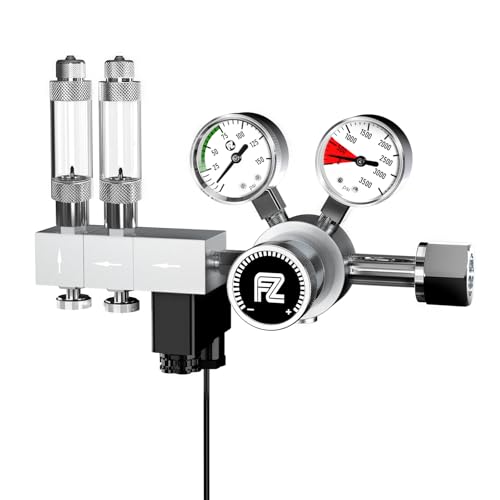
FZONE Pro Series Dual Stage CO2 Regulator (CGA320 (North America))
- Best for
- A pressurized CO2 build on a standard US CO2 cylinder where stable output to the end of the tank matters.
- Skip this if
- You plan to stay low-tech without injected CO2, or you want to use paintball or soda-machine cylinders.
- Cylinder connection
- Suitable for North American CO2 cylinders with CGA320 adapter
- Stages
- Dual stage
- Solenoid
- 12V DC, split-type
- Safety valve
- Releases pressure above 100 PSI
- Needle valve
- Integrated; output as low as 1 bubble every 3 seconds
- Gauges
- Dual 1.6-inch gauges
- Included
- Regulator, 2 bubble counters, installation tools
- Also needs
- CO2 cylinder with CGA-320 valve; CO2 diffuser; CO2-resistant tubing
- Dual-stage design; dual-stage regulators are generally built to keep output steadier as a cylinder empties (FZONE does not make an end-of-tank claim for this model).
- Built-in safety valve that releases above 100 PSI.
- 12V DC solenoid for timer-controlled on/off.
- Cylinder, diffuser, and tubing are not in the listed package contents.
- CGA320 only; not stated for paintball or soda cylinders.
The FZONE Pro is a dual-stage regulator with a CGA-320 inlet, an integrated needle valve, and a 12V DC solenoid that FZONE states works with automatic timers. The cylinder, diffuser, and CO2-resistant tubing are not included. FZONE does not state compatibility with paintball or soda cylinders for this model. Skip it if you plan to stay low-tech, or if you want to use a paintball or soda-machine cylinder. The CO2 regulators and kits guide and the FZONE Pro vs UNS Mini comparison cover alternatives.
The aquarium CO2 system guide explains each component, how to set a bubble rate, and how to use a drop checker.
Planting plan
The plan below works without CO2. Tropica lists every species here except Cryptocoryne parva as low light and low CO2 demand; parva is medium light, low CO2.
| Zone | Species | Notes from Tropica |
|---|---|---|
| Foreground | Cryptocoryne parva | 3 to 6 cm tall; slow; needs more light than most Cryptocoryne and must not be shaded |
| Midground, in substrate | Cryptocoryne wendtii 'Mi Oya' | Slow; about 20 to 30 cm after two months |
| On hardscape | Anubias barteri var. nana | Slow; 5 to 15 cm; attach to stone or wood, do not bury the rhizome |
| On hardscape, midground to back | Java fern (Microsorum pteropus) | Slow; 15 to 30 cm; attach to wood or stone |
| Background | Vallisneria spiralis 'Tiger' | Fast; spreads by runners; leaves 30 to 50 cm long |
| Background | Limnophila sessiliflora | Fast stem plant; can reach about 40 cm; may grow leggy in poor light |
Some practical notes:
- Cryptocoryne parva is slow. Tropica suggests planting individual plants a few centimeters apart; they form a cohesive group after about six months. If you want a quicker foreground in a low-tech tank, use a few small Anubias instead and accept a less carpet-like look.
- Vallisneria leaves outgrow a 12-inch tank and will trail across the surface. Trim leaves at the base, and remove runners that wander into the foreground.
- Fast stems early on. Tropica recommends fast growers at the start to absorb excess nutrients while slower plants establish. Limnophila does that job; thin it once the Cryptocoryne fill in.
- Cryptocoryne often melt after planting. See why aquarium plants melt.
- With CO2, you can add a carpet. Carpeting plants for planted tanks covers options.
For more species, see easy aquarium plants for beginners and the aquarium plants hub. For layout ideas, aquascaping styles explained and choosing aquarium hardscape are good starting points.
Setup sequence
- Level the tank on a stand rated for the full weight, out of direct sun and near an outlet.
- Add substrate with the front-to-back slope above. Rinse it first only if the maker says to.
- Place hardscape and press it in firmly. Tropica places rocks and wood after the substrate.
- Attach Anubias and Java fern to the hardscape while it is dry. See how to attach Anubias and Java fern.
- Fill partway with conditioned water, pouring onto a plate or bag to protect the slope.
- Plant rooted species with tweezers, foreground first, then top up.
- Install filter, heater, and light. If you are adding CO2 now, install the regulator, diffuser, and check valve before filling completely.
- Set the light schedule. Tropica recommends about 6 hours a day for the first two to three weeks, then 8 to 10 hours.
Cycling and livestock
Cycle the tank before adding fish. Test ammonia, nitrite, and nitrate. DrTim's Aquatics, a maker of nitrifying bacteria products, describes the cycle as complete when a full ammonia dose is converted to nitrate with no trace of ammonia or nitrite overnight. Aquarium cycling and water testing explains the full process. Tropica's start-up advice is 25 to 50 percent water changes a couple of times a week for the first three to four weeks, and waiting three to four weeks before adding fish so plants establish. Buce Plant notes that some aquarium soils can release ammonia when first added, which makes those changes more important.
A 20 long has more room than a 10-gallon, but it is still a small tank. Research each species' adult size, group needs, and temperature range before buying, add animals gradually, and quarantine new arrivals as UF/IFAS Extension recommends. The extra length gives more horizontal swimming room than a taller tank of the same volume, which tends to suit active small fish, but that is a general tendency, not a rule. Shrimp and snails fit well in both low-tech and CO2 tanks, though CO2 levels must be watched more carefully with shrimp; see shrimp in planted tanks.
Maintenance
- Weekly: change about 25 percent of the water, which Tropica says limits waste buildup and algae. Wipe the glass and top up evaporation.
- As needed: trim stems and Vallisneria, and remove dead leaves promptly; Tropica notes decaying plant matter feeds algae.
- Every few weeks: rinse filter media in removed tank water. Canisters need periodic hose and impeller cleaning per the maker's manual.
- CO2 tanks: check the bubble rate and drop checker regularly, and the cylinder pressure gauge.
Feed sparingly; Tropica names overfeeding as the most common cause of algae problems. Use the maintenance checklist and the planted tank maintenance routine for a fuller schedule, and planted tank algae troubleshooting if algae appears.
Next steps
- Compare lights for both 20-gallon shapes in the 20-gallon light guide.
- Get a matched equipment and plant list from the setup finder.
- See other builds in the tank setups hub.
- Estimate substrate with the substrate calculator.
Sources
- The right light for your aquarium, Tropica Aquarium Plants
- Fertiliser and CO2 for your aquarium, Tropica Aquarium Plants
- Starting a new aquarium, Tropica Aquarium Plants
- Hardscape and bottom layer in the tank, Tropica Aquarium Plants
- Care, Tropica Aquarium Plants
- Cryptocoryne parva, Tropica Aquarium Plants
- Cryptocoryne wendtii 'Mi Oya', Tropica Aquarium Plants
- Anubias barteri var. nana, Tropica Aquarium Plants
- Microsorum pteropus, Tropica Aquarium Plants
- Vallisneria spiralis 'Tiger', Tropica Aquarium Plants
- Limnophila sessiliflora, Tropica Aquarium Plants
- Freshwater Substrates (Eco-Planted), CaribSea
- Carbon Dioxide (OSH Answers chemical profile), Canadian Centre for Occupational Health and Safety
- The Ornamental Fish Trade: An Introduction with Perspectives for Responsible Aquarium Fish Ownership, UF/IFAS Extension
- Gas cylinder, Wikipedia
- Planted Aquarium Substrate: Soil, Gravel, and Sand, Buce Plant
- Fishless Cycling, DrTim's Aquatics
This page is research-based: we have not tested the equipment or methods ourselves. It draws on the sources listed and established hobby practice.
Keep reading

Best Planted Tank Lights for 20-Gallon Aquariums (2026)
Plant lights matched to the 24-inch 20 high and the 30-inch 20 long, with notes on why the deeper 20 high and 29 need more output.

Best Filters for Planted Tanks: Canisters and HOB Picks by Tank Size (2026)
Canister and hang-on-back filters for planted tanks, grouped by the maker's rated tank volume, with media capacity, placement, and maintenance notes.

Aquarium CO2 Systems Explained: A Planted Tank Guide
When injected CO2 helps a planted tank, how each part of a pressurized system works, how to dial it in safely, and the mistakes that put livestock at risk.