Sponge Filter vs Canister Filter: Which Suits Your Planted Tank?
Air-driven sponge filters and pump-driven canisters compared on flow, media room, shrimp safety, CO2 loss, inline equipment, and maintenance.

A sponge filter is usually enough for a small, lightly stocked planted tank, a shrimp tank, or a fry or quarantine tank, and it is the gentler choice where tiny animals could be pulled into an intake. A canister suits larger planted tanks and CO2-injected tanks better: it holds more media, its pump flow is published so you can size circulation, and its hoses can carry an inline CO2 diffuser or heater. For a low-tech community tank in between, either can work; match the maker's rated tank size first, then decide on flow and maintenance.
What we compared
This page is about the filter type, not a specific model. The planted aquarium filter guide covers every filter type in more depth; here we compare the two on the points that decide the choice in a planted tank:
- Flow and circulation. Whether the maker publishes a flow figure, and whether you can size circulation from it.
- Media capacity. How much room there is for mechanical and biological media.
- Livestock safety. How water enters the filter, which matters for shrimp and fry.
- Gas exchange. How each one affects surface agitation and CO2 loss.
- Inline equipment. Whether you can add a CO2 diffuser or heater to the plumbing.
- Maintenance and failure modes. What each maker asks you to do, and what goes wrong.
Figures come from the makers' product pages and manuals, listed under Sources. We have not tested these filters hands-on.
How each one works
A sponge filter is a block of foam on a lift tube, driven by air. Hikari describes its Bacto-Surge filters as air-driven sponge filters offering mechanical and biological filtration, with a porous sponge whose pores give aerobic bacteria room to grow. Aquatop describes its CAF filters as using an airlift system, with foam that supports bacterial colonization for mechanical and biological filtration. The air pump is sold separately for both. Aquatop says the CAF-40 can also be run from a powerhead.
A canister filter is a sealed container that sits below the tank, with a motor head that pumps water from an intake, through stacked media baskets, and back to the tank through a hose. Fluval's 07 series manual requires the filter to be positioned below the aquarium. EHEIM says the classic 250 can be filled with filter pads and/or loose media.
Side by side
| Product | Fits | Best for | Skip if |
|---|---|---|---|
 Hikari Aquarium Solutions Bacto-Surge Sponge Filter (Small) Hikari Aquarium Solutions Bacto-Surge Sponge Filter (Small)Model 96040 | up to 40 gal; low-tech tanks | A 10 to 40 gallon community, shrimp or grow-out tank that wants a simple air-driven filter. | You need a filter for a tank over 40 gallons or want strong water movement. |
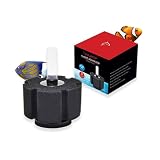 Aquatop Classic Aqua Flow Internal Sponge Filter (Up to 40 gal) Aquatop Classic Aqua Flow Internal Sponge Filter (Up to 40 gal)Model CAF-40 | up to 40 gal; low-tech tanks | A 20 to 40 gallon low-tech or breeding tank that wants a weighted, air-driven sponge. | You want a filter that hides behind hardscape; at 6.75 in tall it is visible in small tanks. |
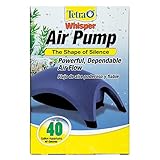 Tetra Whisper Aquarium Air Pump (non-UL) (Whisper 40) Tetra Whisper Aquarium Air Pump (non-UL) (Whisper 40)Model 77853 | up to 40 gal; low-tech tanks | Running a medium sponge filter in a 20 to 40 gallon tank. | Your tank is a nano where a smaller pump is enough. |
 Fluval 107 Performance Canister Filter (107) Fluval 107 Performance Canister Filter (107)Model A440 | 10–30 gal; low-tech tanks, CO2 tanks | A 10-30 US gal planted tank where you want external filtration with room for media. | Your tank is outside the 10-30 US gal range Fluval specifies for this size. |
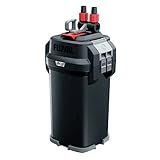 Fluval 207 Performance Canister Filter (207) Fluval 207 Performance Canister Filter (207)Model A443 | 20–45 gal; low-tech tanks, CO2 tanks | A 20-45 US gal planted tank where you want external filtration with room for media. | Your tank is outside the 20-45 US gal range Fluval specifies for this size. |
 EHEIM classic 250 Canister Filter (classic 250) EHEIM classic 250 Canister Filter (classic 250)Model 2213 | 22–66 gal | A planted tank of about 22-66 gal (EHEIM rates it for 80-250 L) where you want a simple, long-proven canister. | Your tank is under about 21 US gal or over about 66 US gal. |
The two types at a glance
| Criterion | Sponge filter | Canister filter |
|---|---|---|
| Drive | Air pump (or a powerhead, for some models such as the Aquatop CAF-40) | Electric pump in the canister head |
| Published flow | Hikari publishes no flow rate for the Bacto-Surge | Published; Fluval gives pump and filter circulation figures, EHEIM a pump output |
| Media | The sponge itself, mechanical and biological | Several baskets or a volume for pads and loose media |
| Media room (examples) | Sponge sizes only, such as 5.00 in diameter for the CAF-40 | 1.2 L basket volume (Fluval 107), 1.8 L (207), 3 L filter volume (EHEIM classic 250) |
| Where it sits | Inside the tank, visible | Below the tank, with intake and return inside |
| Noise source | The air pump, which sits outside the tank | The motor in the canister head |
| Water intake | Through the foam surface | Through an intake tube and strainer |
| Surface effect | Air bubbles break at the surface | Depends on where you aim the return |
| Inline CO2 diffuser or heater | Not applicable | Fits on the hoses if diameters match |
| Main failure modes | Air pump stops; back-siphon into the pump without a check valve | Leaks from seals or hoses outside the tank; worn impeller |
Rated tank sizes for the example products: the Hikari Bacto-Surge Small and Aquatop CAF-40 are each rated up to 40 gal, and Tetra rates the Whisper 40 for 40 gal. Fluval rates the 107 for 10-30 US gal and the 207 for 20-45 US gal, and EHEIM rates the classic 250 for about 80-250 L (about 21-66 US gal).
Choose a sponge filter if
- You keep shrimp or raise fry. Water enters a sponge filter through the foam surface rather than an open intake tube. Hikari lists breeding, fry-holding, and quarantine tanks as uses, and Aquatop calls the CAF-40 particularly useful as a breeding filter and for fry tanks.
- Your tank is small and the stocking light. A sponge rated for your tank, plus a matching air pump, is a simple set. Our sponge filters and air pumps guide pairs sponges and pumps by rated tank size.
- You want a second, gentle filter. Aquatop describes the CAF-40 as useful as a secondary filter and for extra biological filtration in heavily stocked systems.
- You run a quarantine tank. Hikari and Aquatop both list quarantine use. Hikari allows at least 30 days for a new sponge to reach peak performance, so plan ahead rather than starting a sponge on the day you need it.
- You do not inject CO2. In a low-tech tank there is no injected gas to lose, so the bubbles from a sponge filter are not a drawback. See the section on gas exchange below.
Choose a canister filter if
- You inject CO2. You can aim the return to control surface movement, and you can add an inline diffuser to the return hose.
- Your tank is larger or densely planted. Tropica recommends circulating the tank volume 3 to 5 times per hour. Canister makers publish flow figures you can compare against that; sponge makers in our catalog do not.
- You want equipment out of the layout. Only the intake and return sit in the tank; the canister goes in the cabinet.
- You want to choose your media. Canisters take several media types in separate baskets or as loose fill.
Our canister filters for planted tanks guide sorts canisters by tank size, and Fluval 07 series vs EHEIM classic compares the two most common lines.
Consider a hang-on-back instead if
- You want more flow than a sponge without the hoses of a canister. A hang-on-back hangs on the rear rim and is simple to service.
- You have no cabinet space below the tank. Canisters must sit below the aquarium; a hang-on-back does not need that space.
- You do not inject CO2. The waterfall return adds surface movement, which suits a low-tech tank better than an injected one.
The canister filters guide includes hang-on-back alternatives.
Planted-tank specifics
Flow for CO2 and nutrient distribution
Tropica describes the filter's job as creating water circulation, cleaning out fine particles, and housing the micro-biology. In a planted tank, circulation also carries CO2 and nutrients to the leaves; the filter guide explains why dead spots matter. Its recommendation of 3 to 5 tank volumes per hour (450 to 750 L/h for a 150 L tank) can be checked against a canister's published figures. Fluval notes that its filter circulation figures were measured with intake and output hoses of the same length, so real flow with your hoses and media may differ. Hikari publishes no flow rate for its sponges, so with a sponge filter you judge circulation by watching the plants and debris rather than by a number.
Surface agitation and CO2 loss
Gensou explains that more surface movement means more oxygen in and more CO2 out, and that aggressive agitation in an injected tank works against the CO2 system. It also notes that rising bubbles agitate the surface as they burst, with finer bubbles disturbing it less, and suggests air stones as a night-time supplement in planted tanks. A sponge filter runs on rising air, so in a CO2-injected tank it adds agitation all day. With a canister, Gensou suggests positioning the outlet so the water hits the surface at an angle, which lets you tune the ripple.
Inline equipment on canister lines
Canister hoses can carry equipment that would otherwise sit in the tank:
- Inline CO2 diffuser. Dalua's inline diffuser installs by cutting into the canister return hose and securing it between hose sections, in 12/16 mm and 16/22 mm sizes. Dalua notes some fine mist may be visible in the tank, which it describes as normal.
- Inline heater. Hydor's ETH is an external heater sold for canister filters and sumps, in 12 mm and 16 mm hose sizes, and must be installed vertically.
Match the hose size before buying. EHEIM lists 12/16 mm hose for the classic 250; Fluval's manual does not state a hose diameter, so check the product listing or measure the hose. Each inline device also adds resistance in the line.
Maintenance differences
Sponge filter. Hikari says to soak a new sponge in aquarium water for at least five minutes before use, and to rinse it only in water taken from the aquarium, never tap or hot water. Hikari recommends replacing the sponge every six months. Tropica puts filter cleaning at about once a month or a little less often.
Canister filter. Fluval's 07 series manual sets out a schedule: check and clean the impeller monthly, clean and lubricate the motor head gasket, check and clean the hoses every three months, and replace the impeller and motor head gasket yearly. It says to rinse biological media in aquarium water, never tap water, and never replace all media at once, so bacterial colonies are not lost. It also says to unplug the filter before working on it and never to use soap or detergents.
Air pump. Hikari's check valve page explains that a check valve stops water siphoning back through the airline and damaging the pump or causing an electrical short. Fit one if the pump sits below the water line.
Our maintenance checklist helps you schedule filter cleaning alongside water changes and trimming.
Example products
All six are in our catalog, with figures from the makers:
- Hikari Bacto-Surge Small. Rated up to 40 gal, with polyether foam that Hikari says gives longer life. No air pump included, and no flow rate or pore size published.
- Aquatop CAF-40. Rated up to 40 gal, 40 pores per linear inch, with a weighted base. Runs from an air pump or powerhead, neither included. At 6.75 in tall it is visible in small tanks.
- Tetra Whisper 40. An air pump rated for 40 gal with 1.3 L/min airflow per Tetra's Whisper page. It is the non-UL version.
- Fluval 107. Rated for 10-30 US gal, with a 3.9 L canister, 1.2 L of basket volume, and 145 US gal/h (550 L/h) pump performance. Fluval's manual describes an instant-prime handle for starting it and an AquaStop valve that shuts off flow for maintenance.
- Fluval 207. Rated for 20-45 US gal, with a 5.3 L canister and 1.8 L of basket volume.
- EHEIM classic 250. Rated for about 21-66 US gal, with 3 L filter volume and 12/16 mm hose. EHEIM's published flow and wattage are for the EU 50 Hz version, and its page does not list a self-priming feature.
How we compared
- Type first, model second. The examples show typical specifications for each type; they are not ranked.
- Specifications from manufacturer pages and manuals, listed under Sources, with product identity checked against our catalog records.
- Research-based. We have not tested these filters hands-on. We make no claims about noise or flow beyond what the makers publish.
Related guidance
- Planted aquarium filter guide
- Best sponge filters and air pumps
- Best canister filters for planted tanks
- Fluval 07 series vs EHEIM classic
- Browse more options on the Filters: what to check before you buy ↗ hub, or use the setup finder.
Sources
- Bacto-Surge Biological Action Sponge Filters, Hikari
- Internal Sponge Filter CAF-40, Aquatop
- Whisper Aquarium Air Pump, Tetra
- Aquarium Solutions Check Valve, Hikari
- Fluval 07 Series canister filter user manual (doc 09520001), Rolf C. Hagen (PDF hosted by Fishkeeper UK)
- EHEIM classic 250 product page with technical data, EHEIM
- Water circulation in aquariums, Tropica Aquarium Plants
- Surface Agitation in Aquariums: How Much Do You Need?, Gensou Premium Aquascaping
- Inline CO2 Diffuser, Dalua
- ETH external heater, Hydor
This page is research-based: we have not tested the equipment or methods ourselves. It draws on the sources listed and established hobby practice.
Keep reading

Choosing a Filter for a Planted Aquarium
How canister, hang-on-back, sponge, and internal filters suit planted tanks, how to size flow realistically, and how to maintain media without harming the cycle.
Best Sponge Filters and Air Pumps for Betta, Shrimp, and Nano Tanks (2026)
Sponge filters and air pumps for betta, shrimp, fry, and nano planted tanks, paired by the makers' own tank-size ratings.
Best Filters for Planted Tanks: Canisters and HOB Picks by Tank Size (2026)
Canister and hang-on-back filters for planted tanks, grouped by the maker's rated tank volume, with media capacity, placement, and maintenance notes.