Best Substrates for Planted Aquariums: Soils, Gravels, and Sands (2026)
Active aquasoils, porous clay and mineral gravels, and sands for planted tanks, compared by water chemistry, startup ammonia, and long-term upkeep.

Choose the substrate type before the brand. For soft, slightly acidic water and fine-rooted foreground plants, an active aquasoil such as Ultum Nature Systems Controsoil, Tropica Aquarium Soil Powder, or ADA Aqua Soil Amazonia Ver.2 fits, as long as you plan for the startup period. For a permanent bed that does not change pH, Seachem Flourite clay gravels (standard, Black, Red, or Dark) are the stable choice; CaribSea Eco-Complete is a mineral-rich volcanic alternative. For a finer look, Seachem Flourite Black Sand stays pH-neutral, while Seachem Onyx Sand can raise pH slightly. Inert gravels and sands usually need root tabs for heavy root feeders.
Who this guide is for
This guide is for anyone setting up a new planted tank or fully replacing a substrate. The substrate is the hardest thing to change once plants are rooted, so match it to three things first:
- Your water and livestock. Aquasoils lower pH and hardness; most clay gravels here do not change pH; Onyx Sand can raise it. Fish and shrimp that need soft, acidic water and those that need hard, alkaline water point in opposite directions.
- Your plants. Fine grains suit carpeting and foreground plants. Heavy root feeders such as swords and Cryptocoryne need nutrients at the roots, either from a rich soil or from root tabs.
- Your patience at startup. Some aquasoils release ammonia when new, which affects when you can add livestock.
If you plan only epiphytes such as Anubias, Java fern, and mosses, which grow on wood and rock, the substrate matters much less. Our substrate guide covers the trade-offs in depth.
Comparison table
| Product | Fits | Best for | Skip if |
|---|---|---|---|
 Ultum Nature Systems Controsoil (Black, Normal grain, 10 L) Ultum Nature Systems Controsoil (Black, Normal grain, 10 L)Model CON0110C | See notes | A planted or shrimp tank where you want soft, slightly acidic water without the big ammonia release of a rich soil. | You keep livestock that needs hard, alkaline water. |
 Tropica Aquarium Soil Powder (3 L) Tropica Aquarium Soil Powder (3 L)Model 712 | See notes | A nano or small planted tank, or the foreground of a larger one, using carpeting plants. | Your livestock needs hard water or you cannot do the start-up water changes. |
 ADA Aqua Soil - Amazonia Ver.2 (9 L, Normal type) ADA Aqua Soil - Amazonia Ver.2 (9 L, Normal type)Model 104-060 | See notes | A Nature Aquarium-style planted layout where you want a rich soil and can cycle before adding livestock. | You need to add fish or shrimp right away. |
 Seachem Flourite (7 kg / 15.4 lb) Seachem Flourite (7 kg / 15.4 lb)Model Flourite | low-tech tanks, CO2 tanks | A permanent planted substrate that will not break down or shift pH. | You want an aquasoil that lowers pH and softens water. |
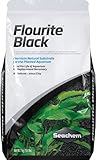 Seachem Flourite Black (7 kg / 15.4 lb) Seachem Flourite Black (7 kg / 15.4 lb)Model Flourite Black | low-tech tanks, CO2 tanks | A dark, permanent clay-gravel substrate for a planted tank. | You want a pH-lowering aquasoil or a lighter-colored substrate. |
 Seachem Flourite Red (7 kg / 15.4 lb) Seachem Flourite Red (7 kg / 15.4 lb)Model Flourite Red | See notes | A planted tank where you want a stable clay gravel that will not shift pH, in a red-brown color. | You want an aqua soil that lowers pH and softens water. |
 Seachem Flourite Dark (7 kg / 15.4 lb) Seachem Flourite Dark (7 kg / 15.4 lb)Model Flourite Dark | See notes | A planted tank where you want a permanent clay gravel in a dark tone without pH change. | You want an aqua soil that buffers pH down for soft-water plants or shrimp. |
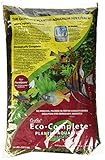 CaribSea Eco-Complete Planted (now Eco-Planted) Black (20 lb) CaribSea Eco-Complete Planted (now Eco-Planted) Black (20 lb)Model 00770 | See notes | A planted tank where you want a long-lasting mineral gravel without the pH drop of an aqua soil. | You are carpeting with very fine-rooted plants and want a fine soil. |
 Seachem Flourite Black Sand (7 kg / 15.4 lb) Seachem Flourite Black Sand (7 kg / 15.4 lb)Model Flourite Black Sand | See notes | A planted tank where you want a fine black clay substrate that will not change water chemistry. | You want a nutrient-rich aqua soil that lowers pH. |
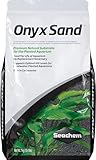 Seachem Onyx Sand (7 kg / 15.4 lb) Seachem Onyx Sand (7 kg / 15.4 lb)Model Onyx Sand | See notes | A planted tank with soft source water where a slight KH and pH lift is welcome. | You are aiming for soft, acidic water. |
Active aquasoils
Aquasoils change water chemistry, pulling pH and hardness down. They differ most in how much nutrient they carry and how much ammonia they release at first.

Ultum Nature Systems Controsoil (Black, Normal grain, 10 L)
- Best for
- A planted or shrimp tank where you want soft, slightly acidic water without the big ammonia release of a rich soil.
- Skip this if
- You keep livestock that needs hard, alkaline water.
- Type
- Aqua soil: natural blend of soil and volcanic ash
- Grain
- Normal (UNS: the standard for larger aquariums and plants with thicker roots); Fine and Extra Fine also offered
- Colors offered
- Black, Brown
- Bag sizes offered
- 1 L (2 gal tank), 3 L (9 gal tank), 10 L (20 gal tank)
- pH effect
- Buffers water to slightly acidic pH (about 6.8 over time) and lowers total water hardness
- Ammonia
- Low ammonia release; does not contain high nutrient levels that can cause ammonia spikes
- Rinsing
- No rinsing required
- No rinsing required, per UNS.
- Low ammonia release compared with nutrient-rich soils, per UNS.
- Buffers toward slightly acidic, softer water.
- Low built-in nutrients; fertilizer needed.
- Lowers pH and hardness, which not every tank wants.
Controsoil buffers water to slightly acidic pH, about 6.8 over time per UNS, and lowers hardness. UNS describes it as low in nutrients by design, with low ammonia release, and says tanks can cycle in under two weeks. The trade-off is that you should plan on fertilizing from the start. UNS still recommends weekly water changes to prevent ammonia spikes. This listing is the Black, Normal grain variant, which UNS describes as the standard for larger tanks and plants with thicker roots; Fine and Extra Fine grains and a Brown color are also offered. No rinsing is required.

Tropica Aquarium Soil Powder (3 L)
- Best for
- A nano or small planted tank, or the foreground of a larger one, using carpeting plants.
- Skip this if
- Your livestock needs hard water or you cannot do the start-up water changes.
- Type
- Complete substrate that can be used without any other type of bottom layer
- Grain size
- 1-2 mm
- Volume
- 3 L
- pH effect
- Affects water chemistry and contributes to a natural reduction in pH
- Recommended depth
- About 8 cm, thicker toward the rear
- Quantity formula
- Length x width x depth (cm) / 1000 = litres needed
- Usable alone with no other bottom layer, per Tropica.
- Fine 1-2 mm grain suits foreground and carpeting plants.
- Frequent water changes recommended for the first 4 weeks.
- 3 L bag is small for larger tanks.
Tropica Aquarium Soil Powder is a fine 1 to 2 mm grain that Tropica positions for small and foreground plants, and it can be used alone without another bottom layer. Tropica says it contributes to a natural reduction in pH and recommends changing 25 to 50 percent of the water twice weekly for the first four weeks after setup. Tropica suggests a depth of about 8 cm, deeper toward the rear. The 3 L bag suits a nano tank or the foreground of a larger one; use the formula below to size larger tanks.

ADA Aqua Soil - Amazonia Ver.2 (9 L, Normal type)
- Best for
- A Nature Aquarium-style planted layout where you want a rich soil and can cycle before adding livestock.
- Skip this if
- You need to add fish or shrimp right away.
- Type
- Aqua soil made from natural black soil
- Included
- Amazonia Supplement (pellet-type solid nutrients, strong nitrogen content)
- Supplement rate
- One packet (50 mL) per 9 L of soil
- Pack sizes offered
- 3 L (104-061), 9 L (104-060), 3 L Powder type (104-063)
- pH effect
- Helps maintain a mildly acidic water environment
- Nutrient supplement included.
- Buffers toward mildly acidic water, per ADA.
- Significant ammonia at startup in ADA's own log.
- Grain size not published in mm.
Amazonia Ver.2 is a rich soil made from natural black soil, with an included pellet supplement that ADA describes as having strong nitrogen content. ADA says it helps maintain mildly acidic water. That richness shows up at startup: in ADA's own setup log, ammonium measured 5.0 mg/L after two weeks and was not detected until about 1.5 months. Plan to cycle the tank before adding livestock. ADA layers it over Power Sand and substrate additives in its setup guide, and warns that other brands' products sold as "Aqua Soil" are not the same product. This listing is the 9 L Normal type.
Porous clay and mineral gravels
These gravels do not break down, so the bed keeps its structure for the life of the tank. Most are not described as nutrient-enriched, so heavy root feeders usually need root tabs.

Seachem Flourite (7 kg / 15.4 lb)
- Best for
- A permanent planted substrate that will not break down or shift pH.
- Skip this if
- You want an aquasoil that lowers pH and softens water.
- Type
- Specially fracted stable porous clay gravel
- Treatment
- Not chemically coated or treated
- pH effect
- Will not alter pH
- Lifespan
- Good for the life of the aquarium; need not be replaced
- Rinsing
- Pre-washed, but rinse before use to remove residual dust
- Sizes offered
- 3.5 kg, 7 kg
- Does not alter pH and does not need replacing.
- Does not soften or decompose, so the bed keeps its structure.
- Needs rinsing; Seachem notes initial cloudiness is normal.
- Not described as nutrient-enriched; heavy root feeders may need root tabs.

Seachem Flourite Black (7 kg / 15.4 lb)
- Best for
- A dark, permanent clay-gravel substrate for a planted tank.
- Skip this if
- You want a pH-lowering aquasoil or a lighter-colored substrate.
- Type
- Specially fracted stable porous clay gravel
- Treatment
- Not chemically coated or treated
- pH effect
- Will not alter pH
- Lifespan
- Good for the life of the aquarium; need not be replaced
- Rinsing
- Pre-washed, but may need rinsing to remove residual dust
- Sizes offered
- 3.5 kg, 7 kg
- Does not alter pH and does not need replacing.
- Will not soften or decompose.
- Needs rinsing before use.
- Not described as nutrient-enriched; heavy root feeders may need root tabs.

Seachem Flourite Red (7 kg / 15.4 lb)
- Best for
- A planted tank where you want a stable clay gravel that will not shift pH, in a red-brown color.
- Skip this if
- You want an aqua soil that lowers pH and softens water.
- Type
- Specially fracted stable porous clay gravel for the natural planted aquarium
- Color
- Red
- Bag sizes offered
- 3.5 kg, 7 kg
- pH effect
- Will not alter the pH of the water
- Rinsing
- Pre-washed, but may become dusty in transit and require rinsing before use
- Lifespan
- Good for the life of the aquarium; need not be replaced
- Does not alter pH, per Seachem.
- Never needs replacing, per Seachem.
- Can be dusty; rinsing and initial cloudiness expected.
- Grain size not published by the maker.
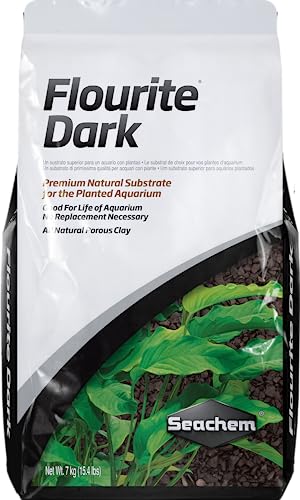
Seachem Flourite Dark (7 kg / 15.4 lb)
- Best for
- A planted tank where you want a permanent clay gravel in a dark tone without pH change.
- Skip this if
- You want an aqua soil that buffers pH down for soft-water plants or shrimp.
- Type
- Specially fracted stable porous clay gravel for the natural planted aquarium
- Color
- Dark
- Bag sizes offered
- 3.5 kg, 7 kg
- pH effect
- Not chemically coated or treated and will not alter the pH of the water
- Rinsing
- Pre-washed, but rinse before use to remove dust; some fine particles may persist
- Lifespan
- Good for the life of the aquarium; need not be replaced
- Does not alter pH, per Seachem.
- Never needs replacing, per Seachem.
- Dusty; rinsing and initial cloudiness expected.
- Grain size not published by the maker.
The four Flourite gravels share the same description: a porous clay gravel that is not chemically coated, will not alter pH, and need not be replaced. The practical difference is color, so choose the tone that suits your layout. Seachem does not publish a grain size for these on its product pages. Seachem says gravel modifiers such as laterite are unnecessary with standard Flourite, and that standard Flourite and Flourite Black work with under-gravel filters. Flourite Black is most effective used alone but can be mixed with other gravels.
All four are pre-washed but dusty. Rinse before use and expect some initial cloudiness, which Seachem calls normal; filter floss or Seachem Clarity can speed clearing. Fill slowly, or pour onto a bowl set on the substrate, to avoid disturbing the bed. Add root tabs for swords, Cryptocoryne, and other heavy root feeders; see our fertilizer basics guide.
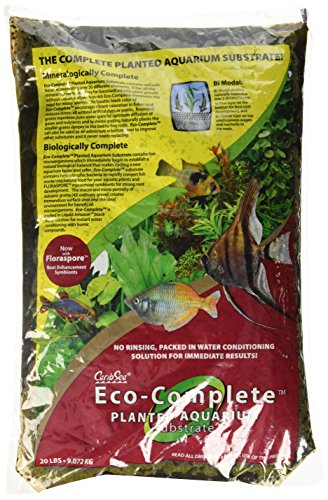
CaribSea Eco-Complete Planted (now Eco-Planted) Black (20 lb)
- Best for
- A planted tank where you want a long-lasting mineral gravel without the pH drop of an aqua soil.
- Skip this if
- You are carpeting with very fine-rooted plants and want a fine soil.
- Type
- Basaltic volcanic planted substrate
- Contains
- Iron, calcium, magnesium, potassium, sulfur, plus over 25 other elements; live heterotrophic bacteria
- Grain size
- 0.25-7.0 mm
- Average density
- 54 lb per cubic foot
- Bag size
- 20 lb (item #00770)
- Finish
- No artificial dyes, paints, or chemical coatings
- Mineral-rich volcanic base with iron.
- Includes live bacteria to help cycling, per CaribSea.
- Wide grain range (0.25-7 mm) is coarser than fine soils for carpeting plants.
- No maker statement on pH effect.
Eco-Complete, now renamed Eco-Planted with the same item numbers, is a basaltic volcanic substrate that CaribSea says contains iron and many other elements plus live heterotrophic bacteria. Its grain range of 0.25 to 7.0 mm is coarser than fine soils, which matters for very fine-rooted carpeting plants. CaribSea suggests mixing in no more than 50 percent of other substrates. The CaribSea page we reviewed does not state a pH effect or rinsing instructions.
Sands
Sand-grade substrates give a finer look. Bottom dwellers such as corydoras are often kept on smooth sand, so check what your livestock needs, since these two behave differently.

Seachem Flourite Black Sand (7 kg / 15.4 lb)
- Best for
- A planted tank where you want a fine black clay substrate that will not change water chemistry.
- Skip this if
- You want a nutrient-rich aqua soil that lowers pH.
- Type
- Specially fracted stable porous clay substrate for the natural planted aquarium (sand grade)
- Color
- Black
- Bag sizes offered
- 3.5 kg, 7 kg
- pH effect
- Will not alter the pH of the water
- Rinsing
- Pre-washed, but rinse before use to remove residual dust; may need multiple rinses
- Lifespan
- Good for the life of the aquarium; need not be replaced
- Mixing
- Can be mixed with other gravels
- Does not alter pH, per Seachem.
- Never needs replacing, per Seachem.
- May need multiple rinses; initial cloudiness expected.
- Grain size not published by the maker.
Flourite Black Sand is the sand grade of Seachem's porous clay line. It will not alter pH, does not need replacing, and can be mixed with other gravels. Seachem notes it may need several rinses, and initial cloudiness is normal.
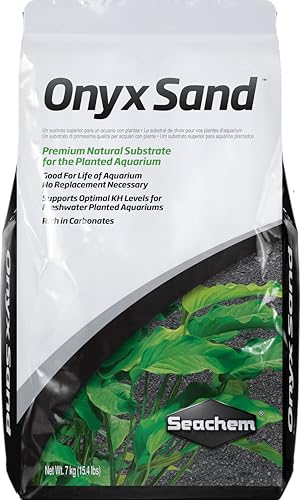
Seachem Onyx Sand (7 kg / 15.4 lb)
- Best for
- A planted tank with soft source water where a slight KH and pH lift is welcome.
- Skip this if
- You are aiming for soft, acidic water.
- Type
- Premium natural sand for the planted aquarium (carbonate rich)
- Color
- Naturally dark gray
- Bag sizes offered
- 3.5 kg, 7 kg
- pH effect
- Slight buffering capacity that may raise pH by 0.1-0.5 units, depending on source water
- Rinsing
- Pre-washed, but may become dusty in transit and require rinsing before use
- Lifespan
- Good for the life of the aquarium; need not be replaced
- Additives
- Seachem states gravel modifiers such as laterite are not necessary
- Never needs replacing, per Seachem.
- Seachem says laterite-type gravel modifiers are not needed.
- Can raise pH by 0.1-0.5 units.
- Grain size not published by the maker.
Onyx Sand is carbonate-rich. Seachem states it has slight buffering capacity that may raise pH by 0.1 to 0.5 units, depending on source water, and supports KH. That suits soft source water where a slight lift is welcome, but not tanks targeting soft, acidic water, such as Caridina shrimp tanks. Seachem says laterite-type modifiers are not needed.
How much to buy
Work out the volume you need from the footprint and depth:
- Measure the inside length and width of the tank.
- Choose a depth. Rooted plants need enough to anchor, and many aquascapers slope higher toward the back. Tropica suggests about 8 cm for its soil, deeper at the rear.
- Multiply length by width by average depth. In centimeters, Tropica's formula is length x width x depth divided by 1,000, which gives litres.
Aquasoils here are sold by volume, so compare your litres directly with the bag size. The Flourite and Onyx bags and Eco-Complete are sold by weight, so you need a density to convert. CaribSea lists an average density of 54 lb per cubic foot for Eco-Complete; the Seachem records we reviewed list none, so ask the maker or allow extra. A sloped layout uses more than a flat bed at the front-edge depth.
Alternatives and when to skip buying
- Skip a new substrate if you plan only epiphytes on wood and rock.
- Keep an existing inert bed and add root tabs rather than tearing down a tank to switch.
- Cap or layer only as each maker describes; ADA's guide layers Amazonia over its own additives, while Tropica's soil is used alone.
- Avoid aquasoils if your livestock needs hard, alkaline water, or if you cannot wait out the startup period.
- Torn between an inert clay gravel and an aquasoil? Our Seachem Flourite vs UNS Controsoil comparison covers pH, hardness, ammonia, and rinsing, and the UNS Controsoil review looks at that soil on its own.
How we chose
- Bag size and grain matched between each Amazon listing and the maker's own product information.
- Specifications from UNS, Tropica, ADA, Seachem and CaribSea, cited in the sources below.
- Rated 4 stars or higher on Amazon when we checked; lower-rated listings were left out.
- Compatibility first: we grouped products by their effect on water chemistry and startup ammonia, then by grain.
- Not tested hands-on. This guide is based on manufacturer documentation and published guidance.
Related guidance
- How to choose aquarium substrate
- Aquarium cycling and water testing
- Easy aquarium plants for beginners
- Planted aquarium fertilizers by need, including root tabs for inert beds
- Water test kits for planted tanks, for tracking ammonia during an aquasoil startup
- Browse the hub: Substrates: what to check before you buy ↗
Sources
- Ultum Nature Systems Controsoil product page, Ultum Nature Systems
- Tropica Aquarium Soil Powder product page, Tropica Aquarium Plants
- Tropica Aquarium Soil Powder 3 L (item 712) product detail, Tropica Aquarium Plants
- ADA AQUA SOIL series product page, Aqua Design Amano
- ADA Aqua Journal: Using Amazonia Ver.2, Aqua Design Amano
- Seachem Flourite product page, Seachem
- Seachem Flourite Black product page, Seachem
- Seachem Flourite Red product page, Seachem
- Seachem Flourite Dark product page, Seachem
- CaribSea Freshwater Substrates page (Eco-Planted), CaribSea
- Seachem Flourite Black Sand product page, Seachem
- Seachem Onyx Sand product page, Seachem
This page is research-based: we have not tested the equipment or methods ourselves. It draws on the sources listed and established hobby practice.
Keep reading

How to Choose Aquarium Substrate for a Planted Tank
Aquasoil, inert gravel, or sand: how each affects plants, water chemistry, cycling, and livestock, plus depth, sloping, and how to estimate quantity.

Aquarium Cycling and Water Testing for Planted Tanks
How the nitrogen cycle works, how to cycle a tank without fish, how to tell when it is ready, and which water tests matter for planted tanks.

Planted Tank Fertilizer Basics
What macro and micronutrients do, liquid fertilizers versus root tabs, how to dose for your real water volume, and how to read plant symptoms without overreacting.