Best Aquarium Water Test Kits for Planted Tanks (2026)
Test kits matched to the job: cycling a new tank, checking GH and KH for CO2 and shrimp, tracking phosphate, and quick strips versus liquid tests.

Buy by the job, not the box. To cycle a new tank, the API Freshwater Master Test Kit covers ammonia, nitrite, nitrate, and pH in one set; the single-parameter API Ammonia, Nitrite, and Nitrate kits replace or top up one test. For hardness, which matters for CO2 tanks and shrimp, add the API GH & KH Test Kit. For fertilizer tracking, the Seachem MultiTest Phosphate kit gives finer steps, while the API Phosphate Test Kit covers a wider phosphate range. We do not currently list an iron test; most tanks can skip one. For quick weekly spot checks, Tetra EasyStrips 6-in-1 give six readings from one strip but no ammonia.
Who this guide is for
This guide is for freshwater planted tank keepers who want to know which tests to own and why. A new tank that is still cycling needs different tests from an established, fertilized tank, and a tank running injected CO2 or keeping shrimp adds hardness to the list. For how the nitrogen cycle works and when a tank is ready for livestock, see our cycling and water testing guide.
The kits below fall into four jobs:
- Cycling: ammonia, nitrite, and nitrate.
- Hardness: GH and KH, for CO2 tanks, shrimp, and pH stability.
- Nutrients: phosphate, for tanks dosing fertilizer.
- Quick checks: dip strips for routine readings between liquid tests.
Quick comparison
| Product | Fits | Best for | Skip if |
|---|---|---|---|
 API Freshwater Master Test Kit (800-test) API Freshwater Master Test Kit (800-test)Model 34 | low-tech tanks, CO2 tanks | Cycling a new planted tank and routine checks of ammonia, nitrite, nitrate, and pH. | You only need hardness readings, or already own separate kits for these parameters. |
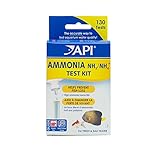 API Ammonia Test Kit API Ammonia Test KitModel LR8600 | low-tech tanks, CO2 tanks | Tracking ammonia while cycling a new planted tank. | You already own the API Freshwater Master Test Kit, which includes ammonia. |
 API Nitrite Test Kit API Nitrite Test KitModel 26 | low-tech tanks, CO2 tanks | Confirming the nitrite stage of a fishless cycle has finished. | You already own the API Freshwater Master Test Kit, which includes nitrite. |
 API Nitrate Test Kit API Nitrate Test KitModel LR1800 | low-tech tanks, CO2 tanks | Weekly nitrate checks in a fertilized planted tank. | You already own the API Freshwater Master Test Kit, which includes nitrate. |
 API GH & KH Test Kit (2.5 oz) API GH & KH Test Kit (2.5 oz)Model 58 | low-tech tanks, CO2 tanks | Checking hardness and buffering before choosing plants and livestock, or when pH is unstable. | You already test GH and KH another way. |
 API Phosphate Test Kit API Phosphate Test KitModel 63L | low-tech tanks, CO2 tanks | Checking phosphate when dosing fertilizers or troubleshooting algae. | You want finer low-range resolution for lean dosing. |
 Seachem MultiTest: Phosphate (75+ tests) Seachem MultiTest: Phosphate (75+ tests)Model 970 | low-tech tanks, CO2 tanks | Fine phosphate tracking in a dosed planted tank. | You only need a rough phosphate check. |
 Tetra EasyStrips 6-in-1 Aquarium Test Strips (25 count) Tetra EasyStrips 6-in-1 Aquarium Test Strips (25 count)Model 19542 | low-tech tanks, CO2 tanks | Quick weekly spot checks of hardness, pH, nitrite, and nitrate. | You are cycling a tank and need ammonia readings. |
Cycling: ammonia, nitrite, nitrate

API Freshwater Master Test Kit (800-test)
- Best for
- Cycling a new planted tank and routine checks of ammonia, nitrite, nitrate, and pH.
- Skip this if
- You only need hardness readings, or already own separate kits for these parameters.
- Parameters
- pH, high range pH, ammonia, nitrite, nitrate
- Contents
- 7 test solutions, 4 test tubes, holding tray, laminated color card, instructions
- Water type
- Freshwater aquariums
- Covers pH, high range pH, ammonia, nitrite, and nitrate in one kit.
- Liquid reagents read against a laminated color card.
- Does not test GH, KH, or phosphate.
- Liquid tests take more steps than dip strips.
This is model 34, the 800-test version. It covers pH, high range pH, ammonia, nitrite, and nitrate, with 7 test solutions, 4 test tubes, a holding tray, and a laminated color card. It does not test GH, KH, or phosphate, so most planted tanks eventually add a hardness kit. Liquid tests take more steps than strips: measure the sample carefully, follow the shake and wait times in the instructions, and read the color in good light. Keep the bottles capped and replace reagents past their expiry date.
API Ammonia Test Kit
- Best for
- Tracking ammonia while cycling a new planted tank.
- Skip this if
- You already own the API Freshwater Master Test Kit, which includes ammonia.
- Parameter
- Ammonia
- Range
- 0 to 8 ppm
- Water type
- Freshwater and saltwater aquariums
- Contents
- Two liquid dropper bottles, instructions, two color charts, test tube with snap-tight cap
- Suggested frequency
- Several times a week for 4-6 weeks in a new aquarium, then weekly
- Covers 0-8 ppm, the range needed while cycling.
- Liquid reagents with a freshwater-specific color chart.
- Ammonia only.
- API does not state the test count.
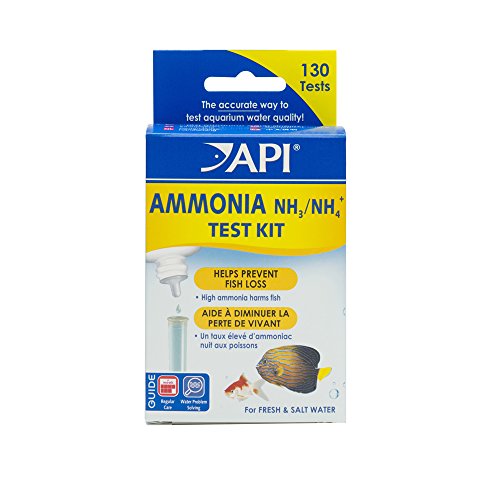
Model LR8600 reads ammonia from 0 to 8 ppm with two liquid dropper bottles and separate freshwater and saltwater color charts; use the freshwater chart. API suggests testing several times a week for the first 4 to 6 weeks of a new aquarium, then weekly. Buy it if you need an ammonia test on its own or run out of ammonia reagent before the rest of a master kit. API does not state the number of tests.

API Nitrite Test Kit
- Best for
- Confirming the nitrite stage of a fishless cycle has finished.
- Skip this if
- You already own the API Freshwater Master Test Kit, which includes nitrite.
- Parameter
- Nitrite
- Range
- 0 to 5 ppm
- Water type
- Freshwater and saltwater aquariums
- Contents
- One nitrite bottle, one capped test tube, instructions, one color card
- Suggested frequency
- Every other day in a new setup, then weekly once the biological filter is established (about 4-6 weeks)
- Single-bottle test.
- 0-5 ppm range covers the nitrite stage of cycling.
- Nitrite only.
- API does not state the test count.
Model 26 is a single-bottle nitrite test with a 0 to 5 ppm range. API suggests testing every other day in a new setup, then weekly once the biological filter is established, about 4 to 6 weeks. It is useful for confirming the nitrite stage of a fishless cycle has passed. The test count is not stated.
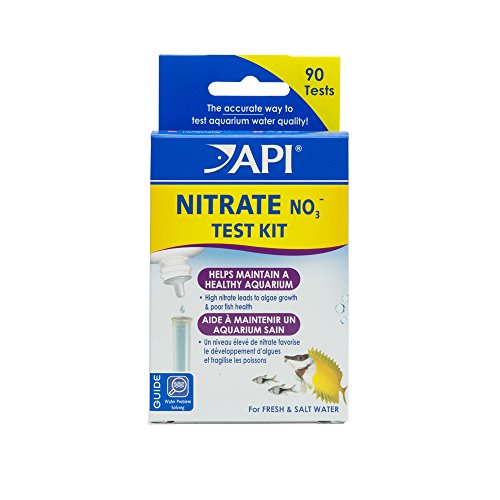
API Nitrate Test Kit
- Best for
- Weekly nitrate checks in a fertilized planted tank.
- Skip this if
- You already own the API Freshwater Master Test Kit, which includes nitrate.
- Parameter
- Nitrate
- Range
- 0 to 160 ppm
- Water type
- Freshwater and saltwater aquariums
- Suggested frequency
- Weekly
- Wide 0-160 ppm range.
- Lets you track nitrate when dosing fertilizers.
- Nitrate only.
- API does not state the test count.
Model LR1800 reads nitrate from 0 to 160 ppm, and API suggests testing weekly. The wide range helps when nitrate has built up or when you dose nitrogen fertilizer. API's page and the product listing describe the contents differently, so check what arrives in the box. The test count is not stated.
Hardness: GH and KH for CO2 and shrimp

API GH & KH Test Kit (2.5 oz)
- Best for
- Checking hardness and buffering before choosing plants and livestock, or when pH is unstable.
- Skip this if
- You already test GH and KH another way.
- Parameters
- General hardness (GH: calcium and magnesium) and carbonate hardness (KH: carbonate and bicarbonate)
- Contents
- KH test bottle, GH test bottle, instructions, two capped test tubes
- Water type
- Freshwater aquariums
- Measures both GH and KH in one kit.
- Helps catch low KH, which API links to rapid pH swings.
- Hardness only; pair it with a kit for ammonia, nitrite, and nitrate.
- Number of tests is not stated on API's page.
Model 58 measures general hardness (calcium and magnesium) and carbonate hardness (carbonate and bicarbonate), with a bottle for each and two capped test tubes. API notes that low KH can lead to rapid and wide pH shifts. In a CO2 tank, KH and pH together are the basis for estimating dissolved CO2, and drop checkers rely on a known KH reagent. Shrimp keepers also use GH and KH to match the water to their species. Pair it with a nitrogen kit; API does not state the number of tests.
Nutrients: phosphate and iron
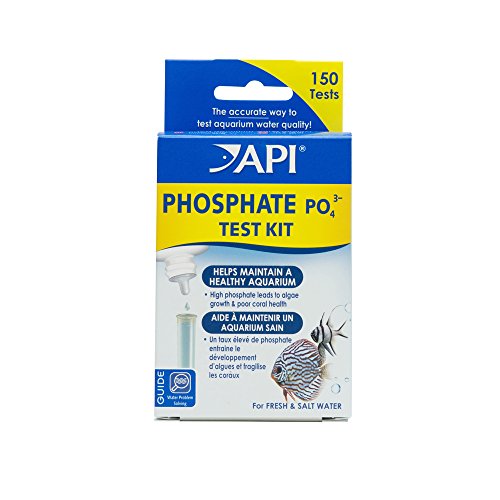
API Phosphate Test Kit
- Best for
- Checking phosphate when dosing fertilizers or troubleshooting algae.
- Skip this if
- You want finer low-range resolution for lean dosing.
- Parameter
- Total phosphate
- Range
- 0 to 10.0 ppm (mg/L)
- Water type
- Freshwater and saltwater aquariums
- Contents
- Two phosphate test bottles, instructions, one capped test tube, two color cards
- Measures phosphate, which the API Freshwater Master Test Kit does not.
- 0-10 ppm range.
- Phosphate only.
- API does not state the test count.
Model 63L measures total phosphate from 0 to 10.0 ppm, with two test bottles, a capped test tube, and two color cards. Phosphate is not in API's master kit, so this fills that gap. The wide range suits troubleshooting algae or checking a heavily dosed tank. If you dose lean and want small steps near zero, the Seachem kit below reads finer.

Seachem MultiTest: Phosphate (75+ tests)
- Best for
- Fine phosphate tracking in a dosed planted tank.
- Skip this if
- You only need a rough phosphate check.
- Parameter
- Phosphate
- Range
- 0-3.0 mg/L
- Detection limit
- Less than 0.05 mg/L
- Resolution
- Color chart changes in 0.001-0.1 mg/L increments
- Tests
- Over 75
- Water type
- Marine and freshwater
- Contents
- Phosphate reagents 1 and 2, phosphate reference, stir rod, sample pipette, color chart, multi-cavity test plate, instructions
- Detects phosphate below 0.05 mg/L.
- Reference solution included.
- Tops out at 3.0 mg/L.
- Phosphate only.
Seachem's model 970 reads phosphate from 0 to 3.0 mg/L, detects below 0.05 mg/L, and changes color in 0.001 to 0.1 mg/L increments, with over 75 tests. A phosphate reference solution is included for checking accuracy. Choose it for fine tracking in a dosed tank; choose the API kit if your readings may exceed 3.0 mg/L.
What about an iron test?
We do not currently list an iron test kit. For most planted tanks, iron testing is optional: many keepers dose a comprehensive fertilizer on a schedule and judge iron by plant growth and leaf color rather than by test results. A dedicated iron test is mainly of interest if you dose iron separately and want to track it. If you do buy one, check whether it reads the chelated iron in your fertilizer, since some kits handle chelated forms differently. See our fertilizer basics for how dosing works.
Quick strips vs liquid tests

Tetra EasyStrips 6-in-1 Aquarium Test Strips (25 count)
- Best for
- Quick weekly spot checks of hardness, pH, nitrite, and nitrate.
- Skip this if
- You are cycling a tank and need ammonia readings.
- Parameters
- Nitrate, nitrite, general hardness (GH), total chlorine, alkalinity (KH), pH
- Method
- Dip strip for one second, hold level 60 seconds, compare with the scale on the bottle
- Sizes
- 4, 25, and 100 count (this record: 25)
- Water type
- Fresh and saltwater aquariums
- Six readings, including GH and KH, from one strip.
- Results in about 60 seconds.
- No ammonia test.
- Strips read against color bands rather than fine steps.
This is the 25-count size (model 19542; Tetra also sells 4 and 100 count). One strip reads nitrate, nitrite, GH, total chlorine, KH, and pH: dip for one second, hold level for 60 seconds, and compare with the scale on the bottle. Tetra says to keep the cap tight, store at room temperature, and avoid moisture, because damp strips give unreliable readings. Strips read against color bands rather than fine steps and include no ammonia test, so use them for routine checks on an established tank and confirm anything unusual with a liquid test.
Alternatives and when to skip buying
- Already own the master kit? You do not need separate API ammonia, nitrite, or nitrate kits unless one reagent runs out. Our API Freshwater Master Test Kit review covers what it measures and what it leaves out.
- Low-tech tank, no fertilizer dosing? Phosphate and iron tests add little; a nitrogen kit and a GH and KH kit usually cover it.
- Unsure about your tap water? Many water utilities publish hardness and pH reports, which can guide which kits you need first.
How we chose
We confirmed each product's identity against Amazon's official product data and took specifications from API, Seachem, and Tetra product pages, listed in the sources below. Kits had to hold a rating of 4 stars or more on Amazon when we checked. We grouped kits by the job they do and favored stated ranges, resolution, and included reference solutions over feature lists. This is a research-based guide: we have not run these tests ourselves, and the kits are not ranked or scored.
Related guidance
- Aquarium cycling and water testing
- Aquarium CO2 system guide, for using KH and pH with a drop checker
- Planted tank algae troubleshooting
- Planted aquarium fertilizers by need, for matching dosing to your nitrate and phosphate results
- CO2 regulators and parts, including drop checkers that rely on a known KH reference
- Water test kits: what to check before you buy ↗
Sources
- API Freshwater Master Test Kit product page, API
- API Ammonia Test Kit product page, API
- API Nitrite NO2 Test Kit product page, API
- API Nitrate NO3 Test Kit product page, API
- API General & Carbonate Hardness Test Kit product page, API
- API Phosphate Test Kit product page, API
- Seachem MultiTest: Phosphate product page, Seachem
- Tetra EasyStrips 6-in-1 Aquarium Test Strips product page, Tetra
- FA16/FA031: Ammonia in Aquatic Systems, University of Florida IFAS Extension
This page is research-based: we have not tested the equipment or methods ourselves. It draws on the sources listed and established hobby practice.
Keep reading

Aquarium Cycling and Water Testing for Planted Tanks
How the nitrogen cycle works, how to cycle a tank without fish, how to tell when it is ready, and which water tests matter for planted tanks.

Planted Tank Fertilizer Basics
What macro and micronutrients do, liquid fertilizers versus root tabs, how to dose for your real water volume, and how to read plant symptoms without overreacting.
Aquarium CO2 Systems Explained: A Planted Tank Guide
When injected CO2 helps a planted tank, how each part of a pressurized system works, how to dial it in safely, and the mistakes that put livestock at risk.