Best Fertilizers for Planted Aquariums, by Need (2026)
All-in-one liquids, single-nutrient supplements, root tabs, and a carbon supplement for planted tanks, matched to what your tank actually lacks.

Pick a fertilizer by what your tank is missing, not by brand. If you want one bottle that covers nitrogen, phosphorus, potassium, iron, and trace elements, look at an all-in-one liquid such as NilocG Thrive. If fish waste already supplies nitrogen and phosphorus, a product without them, such as Tropica Premium Nutrition or Seachem Flourish, fits better. Use single-nutrient bottles (Seachem Flourish Iron, Potassium, or Nitrogen) only when you want to correct one nutrient separately. Add Seachem Flourish Tabs for root-feeding plants on an inert or depleted substrate. Seachem Flourish Excel is a carbon supplement, not a nutrient fertilizer.
Who this guide is for
This guide is for freshwater planted tanks of any size, low-tech or CO2-injected, where plants are growing slowly, showing deficiency signs, or have just been added to a substrate that supplies little on its own. It is organized by need rather than by brand, because the right product depends on three things:
- What your fish load already supplies. Fish waste adds nitrogen and phosphorus. A heavily stocked tank may need only potassium, iron, and trace elements.
- How fast your plants grow. A high-light, CO2-injected tank uses nutrients far faster than a low-tech tank of slow growers.
- What your substrate supplies. A fresh nutrient-rich aquasoil feeds roots for a while; inert gravel and sand do not.
There is no universal dosing schedule here, on purpose. Each product's directions are written for its own concentration, so a capful of one is not equivalent to a capful of another. Follow the maker's label for your real water volume, start at or below it, and adjust slowly. Our fertilizer basics guide explains macros, micros, and how to read plant symptoms.
Comparison table
| Product | Fits | Best for | Skip if |
|---|---|---|---|
 NilocG Aquatics Thrive All-in-One Liquid Aquarium Plant Fertilizer (500 mL / 16.9 oz) NilocG Aquatics Thrive All-in-One Liquid Aquarium Plant Fertilizer (500 mL / 16.9 oz)Model Thrive | low-tech tanks, CO2 tanks | A planted tank keeper who wants a single all-in-one liquid fertilizer. | You keep a dedicated shrimp tank and would rather use the maker's shrimp-specific formula. |
 Seachem Flourish (250 mL / 8.5 fl oz) Seachem Flourish (250 mL / 8.5 fl oz)Model Flourish | low-tech tanks, CO2 tanks | A low-tech or CO2 tank that needs a trace-element supplement alongside root tabs or macros. | You already dose an all-in-one fertilizer that covers trace elements. |
 Tropica Premium Nutrition (Plant Growth Premium Fertiliser) (300 mL) Tropica Premium Nutrition (Plant Growth Premium Fertiliser) (300 mL)Model Premium Nutrition | See notes | A lightly planted or fish-heavy low-tech tank that needs potassium, iron, and trace elements. | You run a densely planted, fast-growing tank whose fish load does not supply enough nitrogen and phosphorus. |
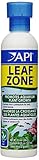 API LEAF ZONE Freshwater Aquarium Plant Fertilizer (8 fl oz) API LEAF ZONE Freshwater Aquarium Plant Fertilizer (8 fl oz)Model 576G | See notes | A beginner low-tech tank with easy plants that needs a simple weekly iron and potassium dose. | You need a complete fertilizer with nitrogen, phosphorus, and trace elements. |
 Seachem Flourish Iron (250 mL / 8.5 fl oz) Seachem Flourish Iron (250 mL / 8.5 fl oz)Model Flourish Iron | See notes | Tanks with red plants or signs of iron deficiency where you want to raise iron separately from other nutrients. | You already use an all-in-one fertilizer and have no sign of iron deficiency. |
 Seachem Flourish Potassium (250 mL / 8.5 fl oz) Seachem Flourish Potassium (250 mL / 8.5 fl oz)Model Flourish Potassium | See notes | Building a separate-macros dosing routine or correcting potassium deficiency (yellowing older leaves). | You want a single all-in-one bottle. |
 Seachem Flourish Nitrogen (250 mL / 8.5 fl oz) Seachem Flourish Nitrogen (250 mL / 8.5 fl oz)Model Flourish Nitrogen | See notes | Heavily planted or CO2 tanks with lightly stocked fish where nitrate runs low. | Your nitrate is already elevated from fish stocking. |
 Seachem Flourish Tabs (10 tabs) Seachem Flourish Tabs (10 tabs)Model Flourish Tabs | low-tech tanks, CO2 tanks | Trying root tabs in a small tank with swords, crypts, or other root feeders. | Your substrate is a fresh nutrient-rich aquasoil, or your tank has few rooted plants. |
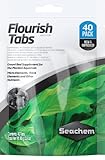 Seachem Flourish Tabs (40 tabs) Seachem Flourish Tabs (40 tabs)Model Flourish Tabs | low-tech tanks, CO2 tanks | Mid-size and larger tanks with many rooted plants on an inert or depleted substrate. | Your substrate is a fresh nutrient-rich aquasoil, or your tank has few rooted plants. |
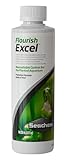 Seachem Flourish Excel (250 mL / 8.5 fl oz) Seachem Flourish Excel (250 mL / 8.5 fl oz)Model Flourish Excel | low-tech tanks, CO2 tanks | A low-tech planted tank where you want a carbon supplement without running pressurized CO2. | Your tank is heavily planted with Anacharis or Vallisneria and you do not want to manage the dosing caution. |
All-in-one and broad liquid fertilizers
These feed through the water column and suit plants that take nutrients through their leaves, including stem plants, epiphytes, and floating plants. They differ mainly in whether they include nitrogen and phosphorus.

NilocG Aquatics Thrive All-in-One Liquid Aquarium Plant Fertilizer (500 mL / 16.9 oz)
- Best for
- A planted tank keeper who wants a single all-in-one liquid fertilizer.
- Skip this if
- You keep a dedicated shrimp tank and would rather use the maker's shrimp-specific formula.
- Type
- All-in-one liquid fertilizer (macro and micronutrients)
- Guaranteed analysis
- N 2.56%, P2O5 1.58%, K2O 9.7%, Mg 0.32%, S 0.54%, Fe 0.42%, Mn 0.168%, B 0.008%, Zn 0.0038%, Mo 0.0006%, Cu 0.0002%
- Dose
- 1 mL per 5 US gal of aquarium water, 1-3 times per week depending on lighting and plant demand
- Coverage
- 500 mL treats up to 2,500 US gal
- Dispensing
- Easy-Dose cap
- Sizes offered
- 500 mL, 2,000 mL refill, 4,000 mL refill
- One bottle covers N, P, K, iron, and trace elements.
- Concentrated: 1 mL per 5 US gal.
- Fixed nutrient ratio cannot be adjusted per nutrient.
- No maker livestock safety statement on the product page; a separate shrimp formula exists.
Thrive is the only product here whose listed analysis covers nitrogen, phosphorus, potassium, iron, and trace elements in one bottle. That convenience comes with a fixed ratio: you cannot raise one nutrient without raising the others. NilocG suggests fewer weekly doses for low-light tanks and more for high-light systems. Because it contains nitrogen and phosphate, check nitrate in a heavily stocked tank before settling on a routine.
The listed analysis includes copper. NilocG's product page text makes no explicit livestock safety statement, and the maker sells a separate shrimp-specific version, Thrive S. Shrimp keepers may prefer that formula. The 500 mL bottle uses an Easy-Dose cap; larger refills are offered.

Seachem Flourish (250 mL / 8.5 fl oz)
- Best for
- A low-tech or CO2 tank that needs a trace-element supplement alongside root tabs or macros.
- Skip this if
- You already dose an all-in-one fertilizer that covers trace elements.
- Type
- Comprehensive liquid supplement for the planted aquarium
- Contains
- Calcium, magnesium, iron, and trace elements (boron, cobalt, copper, manganese, molybdenum, zinc)
- Nitrogen / phosphorus
- No significant levels
- Dose
- 1 capful (5 mL) per 250 L (60 US gal) once or twice a week
- Storage
- Refrigeration recommended 3 months after opening
- Sizes offered
- 50 mL, 100 mL, 250 mL, 500 mL, 2 L, 4 L
- Broad micro and trace element coverage in one bottle.
- Small dose: 5 mL treats 60 US gal.
- Not a complete fertilizer: no significant nitrogen or phosphorus.
- Refrigeration recommended after 3 months open.
Flourish is a broad micronutrient and trace-element supplement, not a complete fertilizer: Seachem states it has no significant nitrogen or phosphorus. It pairs well with root tabs, or with separate macronutrients in tanks that need them. Seachem lists copper among its trace elements and states it is safe for invertebrates such as shrimp at recommended doses. Seachem recommends refrigeration three months after opening, so a smaller bottle may make sense for a nano tank.

- Best for
- A lightly planted or fish-heavy low-tech tank that needs potassium, iron, and trace elements.
- Skip this if
- You run a densely planted, fast-growing tank whose fish load does not supply enough nitrogen and phosphorus.
- Type
- Liquid fertiliser without nitrogen and phosphorus, for aquariums with many fish
- Nitrogen / phosphorus
- N 0.0%, P 0.0%
- Contains
- Potassium, magnesium, sulfur, and micronutrients including iron, boron, copper, manganese, molybdenum, zinc
- Dose
- 6 mL per 50 L per week (pump bottle: 2 mL per push, 3 pushes)
- Water changes
- Tropica recommends at least 25% every two weeks
- Sizes offered
- 125 mL, 300 mL, 750 mL, 3 L
- Measured pump dosing (2 mL per push).
- No N or P, which suits fish-heavy tanks where waste supplies them.
- Not suited alone to fast-growing, high-demand tanks that need N and P.
- Amazon listing brand field shows a distributor name rather than Tropica.
Tropica positions Premium Nutrition for tanks with few plants, slow-growing species, or many fish, where fish waste supplies nitrogen and phosphorus. It contains neither, but covers potassium, magnesium, sulfur, iron, and other micronutrients. The pump bottle measures 2 mL per push. Use Tropica's own dose figure rather than the different figure on the Amazon listing. Tropica's page makes no explicit shrimp or invertebrate statement, and the product contains copper. Tropica also recommends regular water changes alongside it.

API LEAF ZONE Freshwater Aquarium Plant Fertilizer (8 fl oz)
- Best for
- A beginner low-tech tank with easy plants that needs a simple weekly iron and potassium dose.
- Skip this if
- You need a complete fertilizer with nitrogen, phosphorus, and trace elements.
- Type
- Liquid leaf fertilizer for freshwater aquarium plants
- Key nutrients
- Chelated iron and potassium
- Dose
- 5 mL per 10 US gal (38 L) of aquarium water, weekly
- Sizes offered
- 8 fl oz, 16 fl oz
- Use
- Freshwater aquariums with fish and plants only
- Simple weekly dose.
- API states it is safe for shrimp and snails.
- API notes it can stimulate algae growth.
- Narrow nutrient profile (iron and potassium).
Leaf Zone is the simplest option: a weekly dose focused on chelated iron and potassium, with no nitrogen or phosphorus listed. API states it is safe with all freshwater invertebrates, such as shrimp and snails. API also notes that it can stimulate algae growth, and that smaller amounts are less likely to cause a bloom, so start low. API recommends pairing it with its own root tabs.
Single-nutrient supplements
Single-nutrient bottles let you correct one deficiency or build a separate-macros routine. They are tools for keepers who test and watch plants, not a starting point for most beginners.

Seachem Flourish Iron (250 mL / 8.5 fl oz)
- Best for
- Tanks with red plants or signs of iron deficiency where you want to raise iron separately from other nutrients.
- Skip this if
- You already use an all-in-one fertilizer and have no sign of iron deficiency.
- Type
- Iron supplement for the planted aquarium
- Iron concentration
- 10,000 mg/L
- Iron form
- Ferrous gluconate
- Dose
- 1 capful (5 mL) per 200 L (50 US gal), to maintain about 0.10 mg/L iron
- Small doses
- Each cap thread is about 1 mL
- Sizes offered
- 50 mL, 100 mL, 250 mL, 500 mL, 2 L, 4 L
- Also needs
- Iron test kit (Seachem recommends MultiTest Iron) to monitor levels
- Concentrated: 5 mL treats 50 US gal.
- Ferrous (gluconate) iron form.
- Iron only; not a complete fertilizer.
- Seachem advises testing to dose to a target level.
Flourish Iron supplies ferrous gluconate iron only. Seachem pairs the dose with a target iron level and recommends an iron test kit, noting that iron is used rapidly and should be tested within 30 minutes of dosing. Each cap thread measures about 1 mL, which helps with small tanks. Seachem's page makes no specific statement about shrimp or invertebrates.

Seachem Flourish Potassium (250 mL / 8.5 fl oz)
- Best for
- Building a separate-macros dosing routine or correcting potassium deficiency (yellowing older leaves).
- Skip this if
- You want a single all-in-one bottle.
- Type
- Potassium supplement for the planted aquarium
- Potassium concentration
- 41,500 mg/L
- Source
- Potassium sulfate (no nitrogen or phosphorus)
- Dose
- 1 capful (5 mL) per 125 L (30 US gal), raising potassium by 1.66 mg/L; repeat 2-3 times per week or as needed
- Sizes offered
- 50 mL, 100 mL, 250 mL, 500 mL, 2 L, 4 L
- Raises potassium without affecting nitrogen or phosphorus.
- Seachem states it is safe for freshwater shrimp.
- Potassium only; needs pairing with other nutrients.
- Dosed 2-3 times per week.
Flourish Potassium is potassium sulfate, so it raises potassium without adding nitrogen or phosphorus. That makes it useful in fish-heavy tanks where nitrate and phosphate are already present but potassium runs short. Seachem states it is safe for freshwater shrimp, including Amano shrimp.

Seachem Flourish Nitrogen (250 mL / 8.5 fl oz)
- Best for
- Heavily planted or CO2 tanks with lightly stocked fish where nitrate runs low.
- Skip this if
- Your nitrate is already elevated from fish stocking.
- Type
- Nitrogen supplement for the planted aquarium
- Nitrogen concentration
- 15,000 mg/L blend of nitrogen sources
- Nitrogen forms
- Nitrate and ammonium (ammonium is complexed; Seachem states no free ammonia is released)
- Beginner dose
- 2.5 mL (half a cap) per 160 L (40 US gal) twice a week or as needed
- Expert formula
- 0.25 x v x n = mL (v = volume in US gal, n = desired nitrogen increase in mg/L)
- Sizes offered
- 100 mL, 250 mL, 500 mL, 2 L, 4 L
- Provides both nitrate and ammonium forms.
- Seachem states it is safe for shrimp.
- Published formula for dosing to a target increase.
- Nitrogen only; not a complete fertilizer.
- Unnecessary in tanks that already carry nitrate from fish waste.
Flourish Nitrogen blends nitrate and complexed ammonium; Seachem states no free ammonia is released, and that it is safe for invertebrates such as shrimp. Seachem gives a beginner dose and a formula for dosing to a target increase. It is mainly useful in heavily planted or CO2 tanks with light fish stocking. Test nitrate first: tanks with heavy fish loads often have enough already.
Root tabs
Root tabs feed plants through the substrate. Swords, Cryptocoryne, and other heavy root feeders on inert gravel or sand benefit most. Skip them for now on a fresh nutrient-rich aquasoil.

Seachem Flourish Tabs (10 tabs)
- Best for
- Trying root tabs in a small tank with swords, crypts, or other root feeders.
- Skip this if
- Your substrate is a fresh nutrient-rich aquasoil, or your tank has few rooted plants.
- Type
- Gravel bed (root zone) supplement
- Contains
- Trace elements, amino acids, vitamins (incl. iron, manganese, magnesium, calcium, potassium, inositol, choline, B12, biotin)
- Phosphate / nitrate
- None
- Dose
- 1 tab per 10-15 cm (4-6 in) radius; a 10-gallon tank uses 6 tabs
- Replacement
- Add new tabs every 3-4 months
- Coverage
- A 10-tab pack treats a 12 x 30 in plant bed twice
- Feeds rooted plants at the root zone.
- Long interval: replace every 3-4 months.
- Contains no nitrate or phosphate.
- A 10-tab pack covers only a small bed.

Seachem Flourish Tabs (40 tabs)
- Best for
- Mid-size and larger tanks with many rooted plants on an inert or depleted substrate.
- Skip this if
- Your substrate is a fresh nutrient-rich aquasoil, or your tank has few rooted plants.
- Type
- Gravel bed (root zone) supplement
- Contains
- Trace elements, amino acids, vitamins (incl. iron, manganese, magnesium, calcium, potassium, inositol, choline, B12, biotin)
- Phosphate / nitrate
- None
- Dose
- 1 tab per 10-15 cm (4-6 in) radius; a 10-gallon tank uses 6 tabs
- Replacement
- Add new tabs every 3-4 months
- Feeds rooted plants at the root zone.
- 40 tabs cover larger beds or several 3-4 month replacement cycles.
- Contains no nitrate or phosphate.
Both packs are the same product; only the count differs. Seachem places one tab per 10 to 15 cm (4 to 6 in) radius and replaces them every three to four months. The 10-tab pack suits trying tabs in a small tank; the 40-tab pack covers larger beds or several replacement cycles. The tabs contain no nitrate or phosphate. Seachem says they will not alter pH, but in very soft or unbuffered water they have slightly acidic properties similar to peat moss. Push tabs deep into the substrate near the roots so they do not float loose when you replant.
Carbon supplement

Seachem Flourish Excel (250 mL / 8.5 fl oz)
- Best for
- A low-tech planted tank where you want a carbon supplement without running pressurized CO2.
- Skip this if
- Your tank is heavily planted with Anacharis or Vallisneria and you do not want to manage the dosing caution.
- Type
- Bioavailable organic carbon source for the planted aquarium
- Use with CO2
- Can be used as an alternative to CO2 injection or alongside it; Seachem states CO2 by itself gives quantitatively more growth than Flourish Excel alone
- Initial dose
- 1 capful (5 mL) per 40 L (10 US gal) on first use or after a major (>40%) water change
- Maintenance dose
- 1 capful (5 mL) per 200 L (50 US gal) daily or every other day
- Sizes offered
- 50 mL, 100 mL, 250 mL, 500 mL, 2 L, 4 L
- Adds a carbon source to tanks without CO2 injection.
- Can also be used alongside CO2 injection.
- Daily or every-other-day dosing.
- Seachem notes sensitivity in Anacharis and possible Vallisneria melting at high doses.
- Seachem states it gives less growth than CO2 injection alone.
Seachem describes Flourish Excel as a bioavailable organic carbon source. It can be used as an alternative to CO2 injection or alongside it, but Seachem states that CO2 by itself gives quantitatively more growth than Flourish Excel alone. It is not a nutrient fertilizer: it supplies no nitrogen, phosphorus, potassium, or trace elements, so pair it with one of the products above if your plants need nutrients.
Seachem gives a higher initial dose on first use or after a major water change, then a lower maintenance dose daily or every other day. Read the full label before starting.
Livestock safety
Whatever you choose, dose for your real water volume, which is less than the tank's nominal size once substrate and hardscape are in.
Alternatives and when to skip buying
- Skip a new fertilizer if your plants are growing steadily without deficiency signs. More fertilizer does not create growth on its own; light is usually the pacing factor.
- Skip root tabs on a fresh nutrient-rich aquasoil, or in a tank of epiphytes such as Anubias and Java fern that do not root in the substrate.
- Skip single-nutrient bottles if you do not test your water. An all-in-one or broad liquid is easier to manage.
- Fix algae first. If algae is spreading, adding nutrients may make it worse. Our algae troubleshooting guide covers the balance of light, CO2, and nutrients.
- Consider your substrate. If you are still planning the tank, our substrate guide explains which substrates supply nutrients and which need tabs.
How we chose
- Bottle and variant matched between the Amazon listing and the maker's product page.
- Specifications from Seachem, NilocG, Tropica and API documentation, cited in the sources below. Where the Amazon listing and the maker disagreed, we used the maker's figure.
- A 4-star minimum on Amazon at the time we checked.
- Compatibility first: we grouped products by what they supply and noted each maker's livestock statements, or the lack of one.
- Research-based. We have not dosed these products in our own tanks.
Related guidance
- Planted tank fertilizer basics
- Low-tech vs high-tech planted tanks
- How to choose aquarium substrate
- Planted aquarium substrates by type, to see which beds start with nutrients and which need root tabs
- Water test kits for planted tanks, for the nitrate and phosphate tests that guide dosing
- Browse the hub: Fertilizers: what to check before you buy ↗
Sources
- NilocG Thrive All-in-One Liquid Aquarium Plant Fertilizer product page, NilocG Aquatics
- Seachem Flourish product page, Seachem
- Tropica Premium Nutrition product page, Tropica Aquarium Plants
- API LEAF ZONE product page, API Fishcare
- Seachem Flourish Iron product page, Seachem
- Seachem Flourish Potassium product page, Seachem
- Seachem Flourish Nitrogen product page, Seachem
- Seachem Flourish Tabs product page, Seachem
- Seachem Flourish Excel product page, Seachem
This page is research-based: we have not tested the equipment or methods ourselves. It draws on the sources listed and established hobby practice.
Keep reading

Planted Tank Fertilizer Basics
What macro and micronutrients do, liquid fertilizers versus root tabs, how to dose for your real water volume, and how to read plant symptoms without overreacting.

How to Choose Aquarium Substrate for a Planted Tank
Aquasoil, inert gravel, or sand: how each affects plants, water chemistry, cycling, and livestock, plus depth, sloping, and how to estimate quantity.

Low-Tech vs. High-Tech Planted Tanks
How light, CO2, and nutrients work together, what low-tech and high-tech tanks demand in cost and upkeep, and how to choose or upgrade later.