Seachem Flourite vs UNS Controsoil: Which Substrate to Choose?
Inert clay gravel or active aqua soil? How Seachem Flourite and UNS Controsoil differ on pH, hardness, ammonia, rinsing, and upkeep.

These are two different kinds of substrate. Seachem Flourite is a porous clay gravel that, per Seachem, will not alter pH and never needs replacing, but it needs rinsing and is not described as nutrient-enriched. UNS Controsoil is an aqua soil that needs no rinsing and buffers water toward a slightly acidic pH of about 6.8 while lowering hardness, with low ammonia release. Choose by the water chemistry your livestock and plants need, not by which is "better".
What we compared
Substrate is the hardest piece of planted-tank equipment to change later, so we compared these on the points that are difficult to undo:
- Effect on water chemistry. pH and hardness, and whether the substrate changes them.
- Ammonia and cycling. What the makers say about ammonia release and startup.
- Nutrients. Whether plants can rely on the substrate or need fertilizer.
- Preparation. Rinsing, cloudiness, and filling the tank.
- Lifespan and handling. Whether the bed keeps its structure, and what grain and color options exist.
The Flourite family shares the same base material in different colors and grades, so we include the standard, Black, Dark, Red and Black Sand versions. All facts come from Seachem's and UNS's product pages, listed in the sources. We have not tested these substrates hands-on.
Side by side
| Product | Fits | Best for | Skip if |
|---|---|---|---|
 Seachem Flourite (7 kg / 15.4 lb) Seachem Flourite (7 kg / 15.4 lb)Model Flourite | low-tech tanks, CO2 tanks | A permanent planted substrate that will not break down or shift pH. | You want an aquasoil that lowers pH and softens water. |
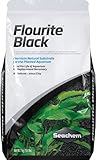 Seachem Flourite Black (7 kg / 15.4 lb) Seachem Flourite Black (7 kg / 15.4 lb)Model Flourite Black | low-tech tanks, CO2 tanks | A dark, permanent clay-gravel substrate for a planted tank. | You want a pH-lowering aquasoil or a lighter-colored substrate. |
 Seachem Flourite Dark (7 kg / 15.4 lb) Seachem Flourite Dark (7 kg / 15.4 lb)Model Flourite Dark | See notes | A planted tank where you want a permanent clay gravel in a dark tone without pH change. | You want an aqua soil that buffers pH down for soft-water plants or shrimp. |
 Seachem Flourite Red (7 kg / 15.4 lb) Seachem Flourite Red (7 kg / 15.4 lb)Model Flourite Red | See notes | A planted tank where you want a stable clay gravel that will not shift pH, in a red-brown color. | You want an aqua soil that lowers pH and softens water. |
 Seachem Flourite Black Sand (7 kg / 15.4 lb) Seachem Flourite Black Sand (7 kg / 15.4 lb)Model Flourite Black Sand | See notes | A planted tank where you want a fine black clay substrate that will not change water chemistry. | You want a nutrient-rich aqua soil that lowers pH. |
 Ultum Nature Systems Controsoil (Black, Normal grain, 10 L) Ultum Nature Systems Controsoil (Black, Normal grain, 10 L)Model CON0110C | See notes | A planted or shrimp tank where you want soft, slightly acidic water without the big ammonia release of a rich soil. | You keep livestock that needs hard, alkaline water. |
Inert versus active, in plain terms
Flourite is described by Seachem as a specially fracted, stable porous clay gravel that is not chemically coated or treated. Seachem states it will not alter pH, will not soften or decompose, and is good for the life of the aquarium. Your tap water's pH and hardness stay in charge.
Controsoil is described by UNS as a natural blend of soil and volcanic ash. UNS states it buffers water to a slightly acidic pH of about 6.8 over time and lowers total hardness. The substrate takes part in your water chemistry, which is the point of an active soil.
Neither is right or wrong. A soft-water shrimp tank and a tank of hard-water livebearers want opposite things. Our substrate guide covers how to match substrate to livestock.
Choose Flourite if
- You want stable water chemistry. Seachem states Flourite will not alter pH, so the substrate will not pull your water toward acidic or soft.
- You keep livestock that prefers harder or alkaline water. Because Flourite does not soften water, it avoids the conflict an acid-buffering soil would create.
- You want a substrate you never replace. Seachem says it is good for the life of the aquarium and will not soften or decompose, so the bed keeps its structure through replanting.
- You want color or grain choices. The family covers standard, Black, Dark and Red gravels plus a sand grade in Black Sand, in 3.5 kg and 7 kg bags.
- You use or might use an under-gravel filter. Seachem lists Flourite and Flourite Black as compatible.
Choose Controsoil if
- You want soft, slightly acidic water. UNS states it buffers to about pH 6.8 and lowers hardness, which suits fish and shrimp that prefer those conditions.
- You want to skip rinsing. UNS states no rinsing is required.
- You are wary of the large ammonia release some rich soils produce. UNS describes Controsoil as low in ammonia release because it does not contain high nutrient levels, and states tanks can cycle in under 2 weeks.
- You want a choice of grain. UNS offers Normal, Fine and Extra Fine. Normal is described as the standard for larger aquariums and plants with thicker roots.
- You want bag sizes keyed to tank size. UNS lists 1 L for about a 2 gal tank, 3 L for 9 gal, and 10 L for 20 gal.
When neither is right
- You want a nutrient-rich soil that feeds plants on its own. Neither is sold that way. Flourite is not described as nutrient-enriched, and Controsoil is low in nutrients by design. See other options on the Substrates: what to check before you buy ↗ hub.
- Your source water is very hard and you do not want to fight it. An acid-buffering soil works against hard water, and Flourite will not soften it. Consider whether your plant and livestock choices suit your water as it is.
- You only keep epiphytes such as anubias and java fern on wood and rock. These plants do not root into the substrate, so a plain gravel or sand may be all you need. Our easy plants guide lists examples.
- Your existing substrate still works. Replacing a substrate means tearing down the tank. Root tabs can often fix poor root feeding in an established bed.
Compatibility and maintenance differences
Setup and cloudiness. Seachem says Flourite is pre-washed but should be rinsed to remove dust, and that some versions, notably Black Sand, may need several rinses. Initial cloudiness is normal; Seachem suggests mechanical filtration such as filter floss or its Clarity product, and filling slowly, for example by pouring water into a bowl on the substrate. Controsoil needs no rinsing per UNS, though filling gently is sensible with any soft substrate.
Fertilizing. Both need help. Seachem notes laterite and similar gravel modifiers are unnecessary with Flourite, but heavy root feeders may still need root tabs. Controsoil's low nutrient content means you should plan on fertilizing from the start. Our fertilizer basics guide explains root tabs versus liquid dosing.
Cycling and water changes. UNS recommends weekly water changes to prevent ammonia spikes, which can be lethal to livestock. Seachem makes no ammonia claim for Flourite either way, since it is inert. With either substrate, cycle the tank fully and test before adding animals; see our cycling and water testing guide.
Long-term upkeep. Seachem states Flourite does not decompose and need not be replaced. UNS does not state a lifespan for Controsoil on its product page, so check your pH and hardness periodically to confirm the buffering effect is still doing what you expect.
Mixing. Seachem says Flourite Black is most effective used alone but may be mixed with other gravels, and Black Sand can be mixed with other gravels. Mixing an inert gravel with an active soil gives you less predictable buffering, so decide which behavior you want before you combine them.
Related guidance
- How to choose aquarium substrate
- Planted tank fertilizer basics
- Low-tech vs high-tech planted tanks
- Browse more options on the Substrates: what to check before you buy ↗ hub, or use the setup finder.
Sources
- Seachem Flourite product page, Seachem
- Seachem Flourite Black product page, Seachem
- Seachem Flourite Dark product page, Seachem
- Seachem Flourite Red product page, Seachem
- Seachem Flourite Black Sand product page, Seachem
- Ultum Nature Systems Controsoil product page, Ultum Nature Systems
This page is research-based: we have not tested the equipment or methods ourselves. It draws on the sources listed and established hobby practice.
Keep reading

How to Choose Aquarium Substrate for a Planted Tank
Aquasoil, inert gravel, or sand: how each affects plants, water chemistry, cycling, and livestock, plus depth, sloping, and how to estimate quantity.

Planted Tank Fertilizer Basics
What macro and micronutrients do, liquid fertilizers versus root tabs, how to dose for your real water volume, and how to read plant symptoms without overreacting.

Aquarium Cycling and Water Testing for Planted Tanks
How the nitrogen cycle works, how to cycle a tank without fish, how to tell when it is ready, and which water tests matter for planted tanks.