How to Grow Aquarium Plants in Sand
Which plants grow in sand, how to place root tabs, planting technique and depth, capping soil with sand, cleaning habits, and when to pick another substrate.

Aquarium plants can grow in sand, but plain sand holds no nutrients and packs down tightly, so it suits some plants far better than others. Epiphytes such as Anubias and Java fern, which attach to wood or rock, do not care what the substrate is. Crypts, swords, and other root feeders grow in sand if you push root tabs deep near their roots and replace them on schedule. If you want a dense bed of rooted plants or a fine carpet, cap a nutrient layer with sand or choose a different substrate for the planted areas.
Sand looks clean and natural, and bottom-dwelling fish such as corydoras benefit from it. The trade-offs are nutrition and compaction. This guide covers how to work around both, and when it is better not to try.
Why sand works, and why it sometimes does not
Three properties decide how plants do in sand.
- No nutrients. Ordinary aquarium sand is inert. It neither feeds roots nor changes water chemistry, unless it contains carbonate (see the Onyx Sand example below). Root feeders depend on what you add.
- Grain size and compaction. Tropica's setup guide recommends gravel with a grain size of roughly 0.8 to 4 mm because it ensures good water circulation around the roots. Fine sand sits at or below the small end of that range, so less water moves through it. Buce Plant notes that sand is often compact enough that roots have difficulty growing and spreading out. Coarser sand behaves more like fine gravel.
- Low-oxygen pockets. Buce Plant also warns that compact sand can form anaerobic (oxygen-poor) areas because little water flows between the particles. How often this becomes a real problem depends on depth, how much waste settles into the bed, and how much roots and animals disturb it. Treat it as a risk to manage, not a certainty.
The upside of compaction is that debris tends to stay on top of sand rather than sinking in, which Buce Plant points out makes it easy to clean.
Which plants suit a sand substrate?
| Plant group | Examples | How it does in sand | What it needs |
|---|---|---|---|
| Epiphytes | Anubias, Java fern, Bucephalandra | Unaffected; they grow on hardscape | Attach to wood or rock; never bury the rhizome |
| Mosses | Java moss | Unaffected | Tie to hardscape |
| Floating plants | Frogbit, Salvinia, Phyllanthus | Unaffected | Thin out regularly |
| Rosette root feeders | Cryptocoryne, Amazon swords, Vallisneria | Grow well with fertilizer | Root tabs near the roots, replaced on schedule |
| Stem plants | Hygrophila, Rotala, Ludwigia | Workable; feed mostly from the water | Liquid fertilizer; root tabs help in an inert bed |
| Carpets | Marsilea hirsuta, dwarf hairgrass, Monte Carlo | Hardest case | A capped nutrient layer, coarser sand, and patience |
Epiphytes are the safest choice. Tropica's instruction for Anubias, for example, is to attach it to a stone or root with fishing line, and not to cover the rhizome if it is planted in the bottom because it tends to rot. That is just as true in sand, where the rhizome would otherwise be buried in a dense layer.
Carpets are where sand struggles most. Fine-leaved carpeting plants spread with runners and fine roots through the top layer of the substrate, which works poorly in a compacted, nutrient-free bed. Marsilea hirsuta, which Tropica rates easy with low light and low CO2 demand and which spreads by runners, is the most forgiving option, though in plain, nutrient-poor sand expect it to fill in more slowly than in a rich substrate. Our guide to carpeting plants covers which species need CO2 and richer substrate.
How to use root tabs in sand
Root tabs are tablets or capsules of fertilizer that you push into the substrate near root-feeding plants. Both makers' directions below are written for any substrate; Aquarium Co-Op states that all substrates, which includes sand, can use root tabs.
- Spacing. Seachem's Flourish Tabs directions say to insert one tab for every 10-15 cm (4-6 in) radius. Aquarium Co-Op's Easy Root Tabs directions say one tab every 4 to 6 inches in a grid pattern.
- Depth. Seachem says to push each tablet midway into the gravel bed; Aquarium Co-Op says at least 1 inch into the substrate. In sand, push the tab down with your finger or long tweezers and smooth the sand back over the hole so it does not float up or leach straight into the water.
- Position. Place tabs near, not on top of, the root ball. For a large sword, Aquarium Co-Op suggests one tab in the center and more in a ring around the plant as roots spread.
- Frequency. Seachem says to add new Flourish Tabs every three to four months. Aquarium Co-Op suggests replacing its tabs monthly or as plants use them. Follow the directions for the product you buy.

Seachem Flourish Tabs (40 tabs)
- Best for
- Mid-size and larger tanks with many rooted plants on an inert or depleted substrate.
- Skip this if
- Your substrate is a fresh nutrient-rich aquasoil, or your tank has few rooted plants.
- Type
- Gravel bed (root zone) supplement
- Contains
- Trace elements, amino acids, vitamins (incl. iron, manganese, magnesium, calcium, potassium, inositol, choline, B12, biotin)
- Phosphate / nitrate
- None
- Dose
- 1 tab per 10-15 cm (4-6 in) radius; a 10-gallon tank uses 6 tabs
- Replacement
- Add new tabs every 3-4 months
- Feeds rooted plants at the root zone.
- 40 tabs cover larger beds or several 3-4 month replacement cycles.
- Contains no nitrate or phosphate.
Per Seachem, Flourish Tabs contain no nitrate or phosphate, so in a tank with few fish you may also need a liquid fertilizer. Skip root tabs if your tank holds only epiphytes, mosses, and floaters. How tabs compare with liquid dosing is covered in planted tank fertilizer basics and in our root tabs vs. liquid fertilizer comparison.
Capping soil with sand, or mixing substrates
If you want many rooted plants and still want sand on show, layer the substrate.
- Capping. Tropica's setup guide describes a nutrient layer of about half a centimetre to 1 cm under the main substrate, with about 1 cm placed where strong-rooted plants will go. A sand cap over that layer keeps it in place. Avoid uprooting plants often in a capped bed, because the lower layer can come to the surface and cloud the water.
- Zoning. Buce Plant describes planting rooted plants in aquarium soil at the back and sides while keeping sand visible at the front, separated by hardscape so the two do not mix. This is often the most practical layout: sand where fish forage, soil where plants grow.
- Mixing grades. Seachem states that Flourite Black Sand can be mixed with other gravels. Fine sand and much coarser gravel may not stay neatly layered, because small grains can settle into the gaps between larger ones, so keeping different grades in separate areas is usually the simpler approach.
Sand options for planted tanks
Two sands in our catalog are sold specifically for planted aquariums. Seachem does not publish a grain size for either.

Seachem Flourite Black Sand (7 kg / 15.4 lb)
- Best for
- A planted tank where you want a fine black clay substrate that will not change water chemistry.
- Skip this if
- You want a nutrient-rich aqua soil that lowers pH.
- Type
- Specially fracted stable porous clay substrate for the natural planted aquarium (sand grade)
- Color
- Black
- Bag sizes offered
- 3.5 kg, 7 kg
- pH effect
- Will not alter the pH of the water
- Rinsing
- Pre-washed, but rinse before use to remove residual dust; may need multiple rinses
- Lifespan
- Good for the life of the aquarium; need not be replaced
- Mixing
- Can be mixed with other gravels
- Does not alter pH, per Seachem.
- Never needs replacing, per Seachem.
- May need multiple rinses; initial cloudiness expected.
- Grain size not published by the maker.
Seachem describes Flourite Black Sand as not chemically coated and states it will not alter pH, and says it is good for the life of the aquarium. It says Flourish Tabs and similar supplements are helpful but not necessities. Seachem says it is pre-washed but may become dusty in transit and need rinsing before use, and that initial cloudiness is normal. Skip it if you want a nutrient-rich aquasoil that softens water.
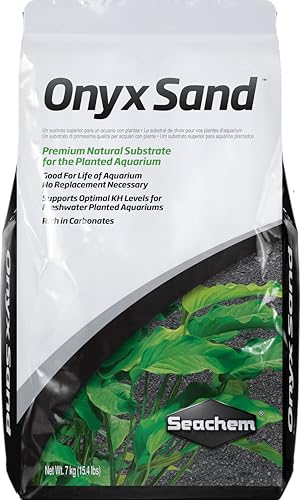
Seachem Onyx Sand (7 kg / 15.4 lb)
- Best for
- A planted tank with soft source water where a slight KH and pH lift is welcome.
- Skip this if
- You are aiming for soft, acidic water.
- Type
- Premium natural sand for the planted aquarium (carbonate rich)
- Color
- Naturally dark gray
- Bag sizes offered
- 3.5 kg, 7 kg
- pH effect
- Slight buffering capacity that may raise pH by 0.1-0.5 units, depending on source water
- Rinsing
- Pre-washed, but may become dusty in transit and require rinsing before use
- Lifespan
- Good for the life of the aquarium; need not be replaced
- Additives
- Seachem states gravel modifiers such as laterite are not necessary
- Never needs replacing, per Seachem.
- Seachem says laterite-type gravel modifiers are not needed.
- Can raise pH by 0.1-0.5 units.
- Grain size not published by the maker.
Onyx Sand is carbonate rich. Seachem says it supports KH and has a slight buffering capacity that may raise pH by 0.1 to 0.5 units, depending on your source water. That can suit soft tap water, but skip it if you are aiming for soft, acidic water, for example for Caridina shrimp.
Plain, inexpensive pool or play sand is also used by many hobbyists. If you go that route, rinse it thoroughly first, as Bulk Reef Supply recommends for any new dry sand, and check that it is free of shells or limestone, which raise hardness. Our substrates buying guide compares sands with aquasoils and clay gravels.
How deep should sand be?
Tropica's general guidance is to slope the substrate from at least 3-4 cm at the front to 6-8 cm at the back, so rooted plants sit in the deepest part. In sand, keep depth where roots will actually use it. A deep bed with no roots in it gains little and gives waste more room to settle. Epiphyte-only areas can use a thin layer.
To work out how many bags you need for a given footprint and slope, use the substrate calculator.
Planting technique in sand
- Plant with the water low. Tropica recommends planting when the water is just a few centimetres above the substrate, which makes placement easier.
- Prepare the plant. Remove pots, rock wool, and lead weights. Tropica suggests trimming roots to about 4 cm and removing older outer leaves on rosette plants.
- Use tweezers. Grip the base of a stem or the roots of a rosette with long tweezers, push it deep into the sand at a slight angle, then withdraw the tweezers. Sand tends to collapse back around the stem, which helps hold it.
- Mind the crown. Set rosette plants so the crown, where leaves meet roots, sits at the sand surface.
- Stop stems floating up. Light stems may pop up in loose sand. Plant them a little deeper, or weigh them down temporarily with a small stone, never a lead weight left in the tank.
- Add root tabs near root feeders once they are planted, following the spacing above.
Our guide to essential aquascaping tools covers tweezer types.
Cleaning sand in a planted tank
- Hover, do not dig. Bulk Reef Supply's cleaning guide says to hover the open end of the vacuum tube just over the surface of the substrate. Pushing the tube into sand pulls up the sand itself and disturbs roots. If sand does get drawn up, Aquarium Co-Op's tip of briefly pinching the hose lets heavier grains drop back while lighter debris is carried away.
- Skip the root zone. Clean the open areas, and leave planted areas mostly alone so roots and root tabs are not disturbed.
- Stir open areas lightly. Gently running your fingers or tweezers through bare sand during a water change helps keep it from packing down. Avoid stirring heavily where plants are rooted.
- Snails. Malaysian trumpet snails are a burrowing species. Aqueon says they burrow in sand or gravel looking for food, which helps keep the substrate from compacting. They breed quickly without a mate, so expect numbers to rise and never release them outdoors.
The planted tank maintenance routine and the maintenance checklist cover the rest of the weekly routine.
Livestock: why sand suits corydoras
Chewy's care guide recommends soft sand or smooth, fine gravel for corydoras to protect their sensitive barbels, which can be damaged by rough substrate. Corydoras sift the bottom for food, and sand lets them do that comfortably. Keep sand areas clean, since the same guide links substrate hygiene to their health. Fish that dig heavily will move fine sand around, so anchor plants well or rely on epiphytes in those tanks.
Limitations
- Root feeders depend on you. Without root tabs, crypts and swords in plain sand often fade over time.
- Sand is a compromise for heavy planting. Buce Plant concludes that even with root tabs, sand is not the best option for a planted aquarium.
- Replanting is messier in a capped bed, since the nutrient layer can surface.
- Sand does not cycle the tank. Like gravel, it releases no ammonia, so you need an ammonia source to cycle. See aquarium cycling and water testing.
When to choose a different substrate
- You want a dense, rooted planted tank or a fine carpet. An aquasoil, or soil zones with sand only at the front, is usually easier. Compare options in how to choose aquarium substrate.
- You keep soft-water shrimp or fish and want the substrate to help lower pH. An aquasoil does that; inert sand does not, and carbonate sand works against it.
- You often rearrange plants. A fine gravel holds stems well and does not compact like fine sand.
Sand is a good fit when you keep epiphytes, a handful of crypts or swords fed with root tabs, and bottom-dwelling fish. If your tank is already set up with sand and your plants are growing, you do not need to change anything. Add root tabs before considering a new substrate.
Next steps
- Choose plants that grow without CO2 or rich substrate in aquarium plants that don't need CO2.
- Compare sands, clay gravels, and aquasoils in our substrates by type.
- Attach epiphytes properly with how to attach Anubias and Java fern.
- Work out quantities with the substrate calculator.
Sources
- Hardscape and bottom layer in the tank, Tropica Aquarium Plants
- Planting in the aquarium, Tropica Aquarium Plants
- Planted Aquarium Substrate: Soil, Gravel, and Sand, Buce Plant
- Easy Root Tabs, Aquarium Co-Op
- Flourish Tabs, Seachem
- Flourite Black Sand, Seachem
- Onyx Sand, Seachem
- Anubias barteri var. nana, Tropica Aquarium Plants
- Marsilea hirsuta, Tropica Aquarium Plants
- Corydoras Catfish Care Guide, Chewy
- Melanoides tuberculata, Wikipedia
- How to Clean Sand or Gravel for the Aquarium, Bulk Reef Supply
- How to Use a Gravel Vacuum to Clean Aquariums, Aquarium Co-Op
- Types of Aquarium Snails, Aqueon
This page is research-based: we have not tested the equipment or methods ourselves. It draws on the sources listed and established hobby practice.
Keep reading
How to Choose Aquarium Substrate for a Planted Tank
Aquasoil, inert gravel, or sand: how each affects plants, water chemistry, cycling, and livestock, plus depth, sloping, and how to estimate quantity.

Best Substrates for Planted Aquariums: Soils, Gravels, and Sands (2026)
Active aquasoils, porous clay and mineral gravels, and sands for planted tanks, compared by water chemistry, startup ammonia, and long-term upkeep.

Planted Tank Fertilizer Basics
What macro and micronutrients do, liquid fertilizers versus root tabs, how to dose for your real water volume, and how to read plant symptoms without overreacting.