Best Water Conditioners and Bacteria Starters for Planted Tanks (2026)
Dechlorinators, bacterial starters and a GH supplement for planted tanks, with each maker's dosing for chlorine and chloramine and their shrimp statements.

Every planted tank filled from a chlorinated tap needs a dechlorinator; the other two products here solve narrower problems. For routine water changes, Seachem Prime treats 50 US gal per capful and Fritz Complete treats 50 US gal per teaspoon, and both makers say they also detoxify ammonia, nitrite and nitrate. Seachem Safe is a dry powder for large volumes. API Tap Water Conditioner, API Stress Coat and Tetra AquaSafe Plus handle chlorine and chloramine without an ammonia-detox claim; Stress Coat is the only conditioner here whose maker states outright that it is safe for invertebrates; Fritz lists invertebrates among Fritz Complete's uses. To start a new tank, Seachem Stability, FritzZyme 7 or Tetra SafeStart Plus add bacteria. Add Seachem Equilibrium only if you fill with RO, DI or very soft water that needs GH put back.
Who this guide is for
This guide is for planted tank keepers choosing what to add to new water. The ten products split into three jobs, and most tanks need only the first:
- Dechlorinators remove chlorine and chloramine from tap water before it reaches your fish, shrimp and filter bacteria.
- Bacterial starters add nitrifying bacteria to help a new tank, or one recovering from medication or a filter change, process waste.
- A GH mineral supplement puts calcium and magnesium back into water that has had them removed, such as RO or DI water.
None of the starters or the mineral supplement removes chlorine, so they are used alongside a conditioner, not instead of one. Our cycling and water testing guide explains how a new tank becomes ready for livestock.
Comparison table
| Product | Fits | Best for | Skip if |
|---|---|---|---|
 Seachem Prime (250 mL) Seachem Prime (250 mL)Model 67104360 | low-tech tanks, CO2 tanks | Routine water changes in any planted tank, including during cycling when ammonia or nitrite shows up. | You need a product with an explicit invertebrate-safe statement from the maker. |
 Seachem Safe (250 g) Seachem Safe (250 g)Model 386 | low-tech tanks, CO2 tanks | Large tanks or big water changes where a liquid conditioner would run out fast. | You keep a small nano tank and want simple capful dosing. |
 Fritz Aquatics Complete Water Conditioner (16 oz) Fritz Aquatics Complete Water Conditioner (16 oz)Model 47515 | low-tech tanks, CO2 tanks | Planted tanks with fish and invertebrates where you want a concentrated conditioner with stated per-dose limits. | You need a dry, ultra-concentrated product for very large water changes. |
 API Tap Water Conditioner (16 oz) API Tap Water Conditioner (16 oz)Model 52C | low-tech tanks, CO2 tanks | Simple dechlorinating for water changes on an established planted tank. | You want a conditioner that also binds ammonia during cycling. |
 API Stress Coat Water Conditioner (16 oz) API Stress Coat Water Conditioner (16 oz)Model 85C | low-tech tanks, CO2 tanks | Shrimp or snail planted tanks where you want a maker-stated invertebrate-safe conditioner. | You want maximum treated volume per bottle or ammonia binding. |
 Tetra AquaSafe Plus Water Conditioner (8.45 oz) Tetra AquaSafe Plus Water Conditioner (8.45 oz)Model 16268 | low-tech tanks, CO2 tanks | Beginners doing small weekly water changes on a 5 to 20 gallon tank. | You change large volumes of water and want a concentrated product. |
 Seachem Stability (250 mL) Seachem Stability (250 mL)Model 126 | low-tech tanks, CO2 tanks | Starting a new planted tank or rebuilding bacteria after medication or a filter change. | You only need to dechlorinate water for an established tank. |
 Fritz Aquatics FritzZyme 7 Live Nitrifying Bacteria (16 oz) Fritz Aquatics FritzZyme 7 Live Nitrifying Bacteria (16 oz)Model 80209 | low-tech tanks, CO2 tanks | Cycling a new freshwater planted tank quickly before adding fish. | Your tank is brackish or saltwater. |
 Tetra SafeStart Plus (8.45 oz) Tetra SafeStart Plus (8.45 oz)Model 77962 | low-tech tanks, CO2 tanks | A beginner starting a new freshwater planted tank who wants one-bottle dosing. | Your tank is already cycled and you only need a dechlorinator. |
 Seachem Equilibrium (300 g) Seachem Equilibrium (300 g)Model 116044608 | low-tech tanks, CO2 tanks | Planted tanks filled with RO, DI or very soft tap water that need GH added back. | Your tap water already has moderate hardness. |
All doses in this guide are the makers' own, from the product pages listed in the sources. Where an Amazon listing disagreed with the maker, we used the maker's figure.
Chlorine vs chloramine: what the dosing tells you
Water utilities disinfect with chlorine, chloramine or both, and your utility's water report should say which. It matters because several makers give a different, higher dose for chloramine:
- API Tap Water Conditioner: 1 mL per 10 US gal (38 L) for chlorine and heavy metals, but 5 mL per 30 US gal (114 L) for chloramines.
- Seachem Prime and Seachem Safe: Seachem says a double dose may be used safely where chloramine levels are high.
- API Stress Coat, Fritz Complete and Tetra AquaSafe Plus each give a single dose that covers both chlorine and chloramine.
If your water uses chloramine, follow the chloramine dose for the product you choose.
Dechlorinators for water changes

Seachem Prime (250 mL)
- Best for
- Routine water changes in any planted tank, including during cycling when ammonia or nitrite shows up.
- Skip this if
- You need a product with an explicit invertebrate-safe statement from the maker.
- Type
- Concentrated liquid water conditioner
- Removes
- Chlorine and chloramine
- Detoxifies
- Ammonia, nitrite, nitrate; heavy metals at typical tap-water levels
- Dose
- 5 mL (1 capful) per 200 L (50 US gal) of new water
- High chloramine
- Double dose may be used safely
- Emergency nitrite
- Up to 5x normal dose
- pH effect
- Non-acidic; will not impact pH
- Water type
- Fresh and salt
- Size
- 250 mL
- One capful treats 50 gallons.
- Also detoxifies ammonia, nitrite and nitrate.
- Does not change pH.
- Seachem makes no specific statement about shrimp or invertebrates.
- Small doses for nano tanks need careful measuring.
Prime is a concentrated liquid that removes chlorine and chloramine. Seachem says it also detoxifies ammonia, nitrite and nitrate, and heavy metals at typical tap-water levels. The dose is 5 mL (one capful) per 200 L (50 US gal) of new water. Seachem says a double dose may be used safely for high chloramine, and up to five times the normal dose in a nitrite emergency. It's non-acidic and Seachem says it won't affect pH. It works in fresh and salt water. This pick is Seachem's 250 mL bottle. In a nano tank the dose is a small fraction of a capful, so measure carefully.

Seachem Safe (250 g)
- Best for
- Large tanks or big water changes where a liquid conditioner would run out fast.
- Skip this if
- You keep a small nano tank and want simple capful dosing.
- Type
- Dry powder water conditioner
- Removes
- Chlorine and chloramine
- Detoxifies
- Ammonia, nitrite and nitrate
- Dose (chlorine/chloramine)
- 1.25 g (1/4 tsp) per 1,250 L (300 US gal)
- Dose (ammonia)
- 1.25 g (1/4 tsp) per 300 L (75 US gal)
- High chloramine
- Double dose may be used safely
- Emergency
- Up to 4x normal dose for nitrite and nitrate
- pH effect
- Non-acidic; will not impact pH
- Water type
- Fresh and salt
- Size
- 250 g
- Very concentrated: 1/4 tsp treats 300 gallons for chlorine/chloramine.
- Does not change pH.
- Powder must be measured; hard to dose small tanks.
- Seachem advises against storing it as a premixed liquid.
Safe is Seachem's dry powder conditioner, and it's very concentrated. For chlorine and chloramine, the dose is 1.25 g (1/4 tsp) per 1,250 L (300 US gal). For ammonia, Seachem gives 1.25 g per 300 L (75 US gal). As with Prime, Seachem says a double dose may be used safely for high chloramine, and up to four times the normal dose for nitrite and nitrate emergencies. It's non-acidic and won't affect pH. Seachem doesn't recommend mixing Safe into a liquid and storing it for later, so measure the powder fresh each time. The doses are easiest to use when you change large volumes of water.

Fritz Aquatics Complete Water Conditioner (16 oz)
- Best for
- Planted tanks with fish and invertebrates where you want a concentrated conditioner with stated per-dose limits.
- Skip this if
- You need a dry, ultra-concentrated product for very large water changes.
- Type
- Concentrated liquid water conditioner
- Removes
- Chlorine and chloramine
- Detoxifies
- Ammonia, nitrite, nitrate and heavy metals
- Dose
- 1 tsp (5 mL) per 50 US gal (189 L)
- Capacity per dose
- Neutralizes up to 0.5 ppm ammonia, 1.0 ppm nitrite and 15 ppm nitrate
- High ammonia
- Dose may be increased or repeated up to 5x within 24 hours
- pH effect
- Does not affect pH
- Water type
- Fresh and saltwater, including reef and planted aquariums
- Size
- 16 fl oz
- One teaspoon treats 50 gallons.
- Fritz states how much ammonia, nitrite and nitrate each dose handles.
- Fritz names planted aquariums and invertebrates in its use list.
- Ammonia binding per dose is limited (0.5 ppm per Fritz).
- Shrimp are not named specifically.
Fritz Complete removes chlorine and chloramine and, according to Fritz, detoxifies ammonia, nitrite, nitrate and heavy metals. The dose is 1 tsp (5 mL) per 50 US gal (189 L). Unusually, Fritz states the limits of each dose: up to 0.5 ppm ammonia, 1.0 ppm nitrite and 15 ppm nitrate. For high ammonia, the dose may be increased or repeated up to five times within 24 hours. Fritz says it doesn't affect pH and lists it for fresh and saltwater, including reef and planted aquariums. This is the 16 oz size.

API Tap Water Conditioner (16 oz)
- Best for
- Simple dechlorinating for water changes on an established planted tank.
- Skip this if
- You want a conditioner that also binds ammonia during cycling.
- Type
- Concentrated liquid water conditioner
- Neutralizes
- Chlorine, chloramines and other tap-water chemicals; detoxifies heavy metals
- Dose (chlorine/heavy metals)
- 1 mL per 10 US gal (38 L) of tap water
- Dose (chloramines)
- 5 mL per 30 US gal (114 L) of tap water
- Water type
- Fresh and salt
- Size
- 16 fl oz
- Small 1 mL dose per 10 gallons for chlorine.
- Separate dose given for chloramine water.
- API does not claim ammonia, nitrite or nitrate detox for this product.
- Chloramine water needs a higher dose.
API Tap Water Conditioner (model 52C) neutralizes chlorine, chloramines and other tap-water chemicals, and detoxifies heavy metals. The chlorine dose is small at 1 mL per 10 US gal. For chloramines, API gives 5 mL per 30 US gal, which is a much larger dose. The Amazon listing states 1 mL per 20 gal; we use API's figures. API doesn't claim ammonia, nitrite or nitrate detox for this product, so it's a plain dechlorinator for an established tank.

API Stress Coat Water Conditioner (16 oz)
- Best for
- Shrimp or snail planted tanks where you want a maker-stated invertebrate-safe conditioner.
- Skip this if
- You want maximum treated volume per bottle or ammonia binding.
- Type
- Liquid water conditioner with aloe vera
- Removes
- Chlorine and chloramines; detoxifies heavy metals
- Dose
- 5 mL per 10 US gal of aquarium water
- Slime coat
- Double the dose to replace slime coat and repair damaged skin and fins
- Water type
- Fresh and salt; not recommended with a protein skimmer
- Size
- 16 fl oz
- API explicitly states it is safe for invertebrates and plants.
- Aloe vera for fish skin and slime coat.
- 5 mL per 10 gallons, so a bottle treats less water than concentrated conditioners.
- API makes no ammonia-detox claim for it.
Stress Coat (model 85C) removes chlorine and chloramines, detoxifies heavy metals, and contains aloe vera. The dose is 5 mL per 10 US gal of aquarium water. API says doubling the dose helps replace slime coat and repair damaged skin and fins. It works in fresh and salt water, though API doesn't recommend it with a protein skimmer. Its main draw for planted tanks is API's explicit statement that it is safe for fish, invertebrates and aquarium plants. Because the dose is 5 mL per 10 gallons, a bottle treats less water than the concentrated conditioners above, and API makes no ammonia-detox claim for it.
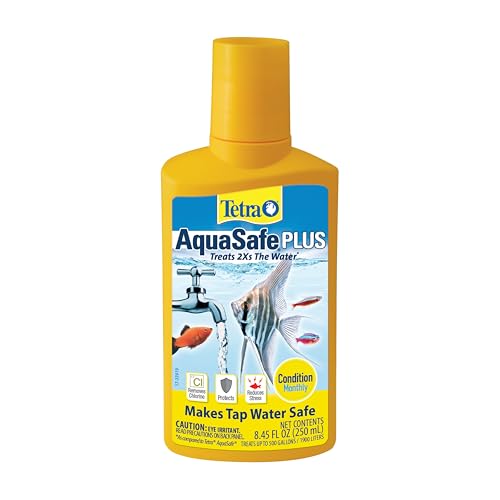
Tetra AquaSafe Plus Water Conditioner (8.45 oz)
- Best for
- Beginners doing small weekly water changes on a 5 to 20 gallon tank.
- Skip this if
- You change large volumes of water and want a concentrated product.
- Type
- Liquid water conditioner
- Neutralizes
- Chlorine, chloramines and heavy metals
- Formula
- BioExtract with natural biopolymers, vitamins and minerals
- Dose
- 1 tsp (5 mL) per 10 US gal (38 L)
- Water type
- Freshwater and marine
- Size
- 8.45 fl oz
- Works in seconds per Tetra.
- Simple teaspoon-per-10-gallons dosing.
- 5 mL per 10 gallons, so a bottle treats less water than concentrated conditioners.
- Tetra makes no ammonia-detox claim for it.
AquaSafe Plus neutralizes chlorine, chloramines and heavy metals, and Tetra says it works in seconds. Its BioExtract formula includes natural biopolymers, vitamins and minerals. The dose is 1 tsp (5 mL) per 10 US gal (38 L), for freshwater and marine tanks. Tetra makes no ammonia-detox claim for it. Tetra's SafeStart Plus instructions say to condition tap water with AquaSafe first, so the two are designed as a pair.
Bacterial starters for new tanks
These add bacteria; they don't remove chlorine. Fritz and Tetra say to condition tap water before adding their starters, and Seachem doesn't sell Stability as a dechlorinator either, so use a conditioner with all three. Whichever you use, keep testing ammonia and nitrite as the tank establishes. Our water test kit picks cover the tests you need.

Seachem Stability (250 mL)
- Best for
- Starting a new planted tank or rebuilding bacteria after medication or a filter change.
- Skip this if
- You only need to dechlorinate water for an established tank.
- Type
- Bacterial starter (biofilter establishment)
- Bacteria
- Blend of aerobic, anaerobic and facultative bacteria; non-sulfur fixing, no hydrogen sulfide
- New tank dose
- 5 mL per 40 L (10 US gal) on day one, then 5 mL per 80 L (20 US gal) daily for 7 days
- Maintenance dose
- 5 mL per 80 L (20 US gal) monthly or with water changes, new fish, or medication
- Overdose
- Seachem says it is very hard to overdose
- Water type
- Freshwater and marine
- Size
- 250 mL
- Clear day-by-day dosing schedule for new tanks.
- Seachem says it is very hard to overdose.
- Maker states it is harmless to aquatic organisms and plants.
- Not a dechlorinator; you still need a conditioner.
- New-tank schedule runs 7 days of dosing.
Stability is a blend of aerobic, anaerobic and facultative bacteria. Seachem says it is non-sulfur fixing and produces no hydrogen sulfide. For a new tank, dose 5 mL per 40 L (10 US gal) on day one, then 5 mL per 80 L (20 US gal) daily for 7 days. For maintenance, Seachem gives 5 mL per 80 L monthly, or when you do water changes, add fish or use medication. Seachem says it's very hard to overdose. It's for freshwater and marine tanks.
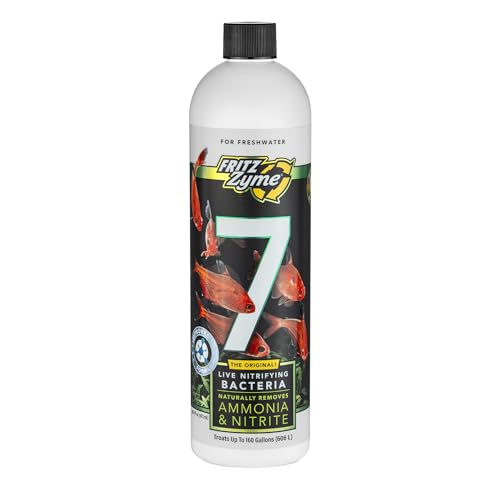
Fritz Aquatics FritzZyme 7 Live Nitrifying Bacteria (16 oz)
- Best for
- Cycling a new freshwater planted tank quickly before adding fish.
- Skip this if
- Your tank is brackish or saltwater.
- Type
- Live nitrifying bacteria for freshwater
- New tank dose
- 4 oz (119 mL / 1/2 cup) per 10 US gal (38 L); livestock can be added within 24 hours
- Maintenance dose
- 1 oz (30 mL) per 10 US gal (38 L)
- Bottle capacity
- 16 oz (473 mL) treats up to 160 US gal (606 L)
- Prep
- Remove chlorine and chloramines with a water conditioner first
- Storage
- Live product; do not freeze or overheat; store cool and dark
- Water type
- Freshwater (FritzZyme 9 is the brackish/saltwater version)
- Live bacteria; Fritz says fish can go in within 24 hours.
- Fritz lists invertebrates and live plants as compatible.
- Large new-tank dose (4 oz per 10 gallons).
- Must be kept from freezing or overheating.
FritzZyme 7 is live nitrifying bacteria for freshwater. The new-tank dose is large: 4 oz (119 mL, or 1/2 cup) per 10 US gal (38 L). Fritz says livestock can be added within 24 hours. The maintenance dose is 1 oz (30 mL) per 10 US gal, and the 16 oz (473 mL) bottle treats up to 160 US gal (606 L). Remove chlorine and chloramines with a conditioner first. Because it's a live product, Fritz says not to freeze or overheat it and to store it somewhere cool and dark. Fritz states FritzZyme 7 is for freshwater use and FritzZyme 9 is the brackish and saltwater version.

Tetra SafeStart Plus (8.45 oz)
- Best for
- A beginner starting a new freshwater planted tank who wants one-bottle dosing.
- Skip this if
- Your tank is already cycled and you only need a dechlorinator.
- Type
- Live bacteria starter for new freshwater aquariums
- New tank dose
- Entire bottle for aquariums up to 100 US gal
- Maintenance dose
- 1 tsp (5 mL) per 10 US gal when adding fish, after water changes, or after replacing filter media
- Prep
- Condition tap water with Tetra AquaSafe first
- Storage
- Live bacteria; do not freeze or expose to heat
- Water type
- Freshwater
- Size
- 8.45 fl oz
- One whole bottle starts a new tank up to 100 gallons.
- Tetra says it reduces ammonia and nitrite in new tanks.
- Freshwater only.
- Must be kept from freezing or heat.
SafeStart Plus (model 77962) is a live bacteria starter for new freshwater aquariums, and Tetra says it reduces ammonia and nitrite in new tanks. For a new tank, you add the entire 8.45 oz bottle to an aquarium of up to 100 US gal. The maintenance dose is 1 tsp (5 mL) per 10 US gal when adding fish, after water changes, or after replacing filter media. Tetra says to condition tap water with AquaSafe first, and to keep the bottle from freezing or heat.
GH supplement for RO or very soft water

Seachem Equilibrium (300 g)
- Best for
- Planted tanks filled with RO, DI or very soft tap water that need GH added back.
- Skip this if
- Your tap water already has moderate hardness.
- Type
- Mineral (GH) supplement for planted aquariums
- Contains
- Calcium, magnesium and potassium salts; no sodium or chloride
- Dose
- 16 g (1 tbsp) per 80 L (20 US gal) raises GH by 1 meq/L (3 dH)
- Intended water
- RO, DI, or any mineral-deficient water
- KH
- Does not maintain KH; Seachem recommends Alkaline Buffer for that
- Size
- 300 g
- Made by Seachem specifically for planted aquariums.
- No sodium or chloride.
- Clear GH-per-dose instructions.
- Does not raise or hold KH.
- Only needed with soft, RO or DI water.
Equilibrium is a mineral supplement, not a conditioner. Seachem makes it for planted aquariums filled with RO, DI or any mineral-deficient water. It contains calcium, magnesium and potassium salts, with no sodium or chloride. The dose is 16 g (1 tbsp) per 80 L (20 US gal), which Seachem says raises GH by 1 meq/L (3 dH). It doesn't maintain KH; Seachem recommends its Alkaline Buffer for that. Use it alongside a dechlorinator if any of your water comes from the tap. Test GH before and after dosing so you know where you're starting from.
How to choose
Do you need ammonia binding? If you're cycling a tank or ammonia sometimes shows up on a test, choose a conditioner whose maker claims ammonia detox: Prime, Safe or Fritz Complete. For an established tank with zero ammonia, a plain dechlorinator such as API Tap Water Conditioner or AquaSafe Plus does the job.
How much water do you change? Concentrated products (Prime and Fritz Complete at 50 US gal per 5 mL, Safe at 300 US gal per 1/4 tsp) suit large tanks and big water changes. Products dosed at 5 mL per 10 US gal (Stress Coat, AquaSafe Plus) run out faster but are easy to measure for small tanks.
Do you keep invertebrates? If you want a maker statement that covers invertebrates, API Stress Coat states it outright, and Fritz Complete includes invertebrates in its use list. See the shrimp callout above for the full picture.
Is the tank new? Add a bacterial starter in the first weeks, alongside a conditioner, and keep testing.
Alternatives and when to skip buying
- Already have a conditioner you trust? You don't need a second one.
- Established, cycled tank? A bacterial starter isn't needed for routine water changes. The makers' maintenance doses are tied to events such as medication, new fish or replacing filter media.
- Tap water with moderate hardness? Skip Equilibrium. It is only for RO, DI or mineral-deficient water. A GH test tells you which you have.
- Well water or untreated water? If your water isn't chlorinated, ask your supplier or test it; a dechlorinator is for treated tap water.
Build the conditioner into your routine with our planted tank maintenance routine and the maintenance checklist.
How we chose
Each product was matched to its Amazon listing by model and size, and doses and claims come from the makers' product pages listed in the sources below. Where the Amazon listing and the maker disagreed, we used the maker's figure: that applies to the API Tap Water Conditioner dose, the size of Seachem Prime, and whether FritzZyme 7 suits brackish water. We grouped products by job and reported each maker's invertebrate statement word for word, or noted that there isn't one. We only included products with strong buyer feedback when we checked. This is a research-based guide: we haven't tested these products ourselves, and we don't rank or score them.
Related guidance
Sources
- Prime product page, Seachem
- Safe product page, Seachem
- Stability product page, Seachem
- Equilibrium product page, Seachem
- TAP WATER CONDITIONER product page, API
- STRESS COAT Aquarium Water Conditioner product page, API
- Fritz Complete product page, Fritz Aquatics
- FritzZyme 7 product page, Fritz Aquatics
- AquaSafe Plus product page, Tetra
- SafeStart Plus 8.45 oz product page, Tetra
This page is research-based: we have not tested the equipment or methods ourselves. It draws on the sources listed and established hobby practice.
Keep reading

Aquarium Cycling and Water Testing for Planted Tanks
How the nitrogen cycle works, how to cycle a tank without fish, how to tell when it is ready, and which water tests matter for planted tanks.
Keeping Shrimp in Planted Tanks
How to keep Neocaridina and Caridina dwarf shrimp with live plants: water parameters, copper risk, aquasoil, filter safety, acclimation, and fertilizer cautions.
A Planted Tank Maintenance Routine
A practical weekly and monthly maintenance routine for low-tech and CO2 planted tanks: water changes, trimming, filters, fertilizers, testing, and equipment.